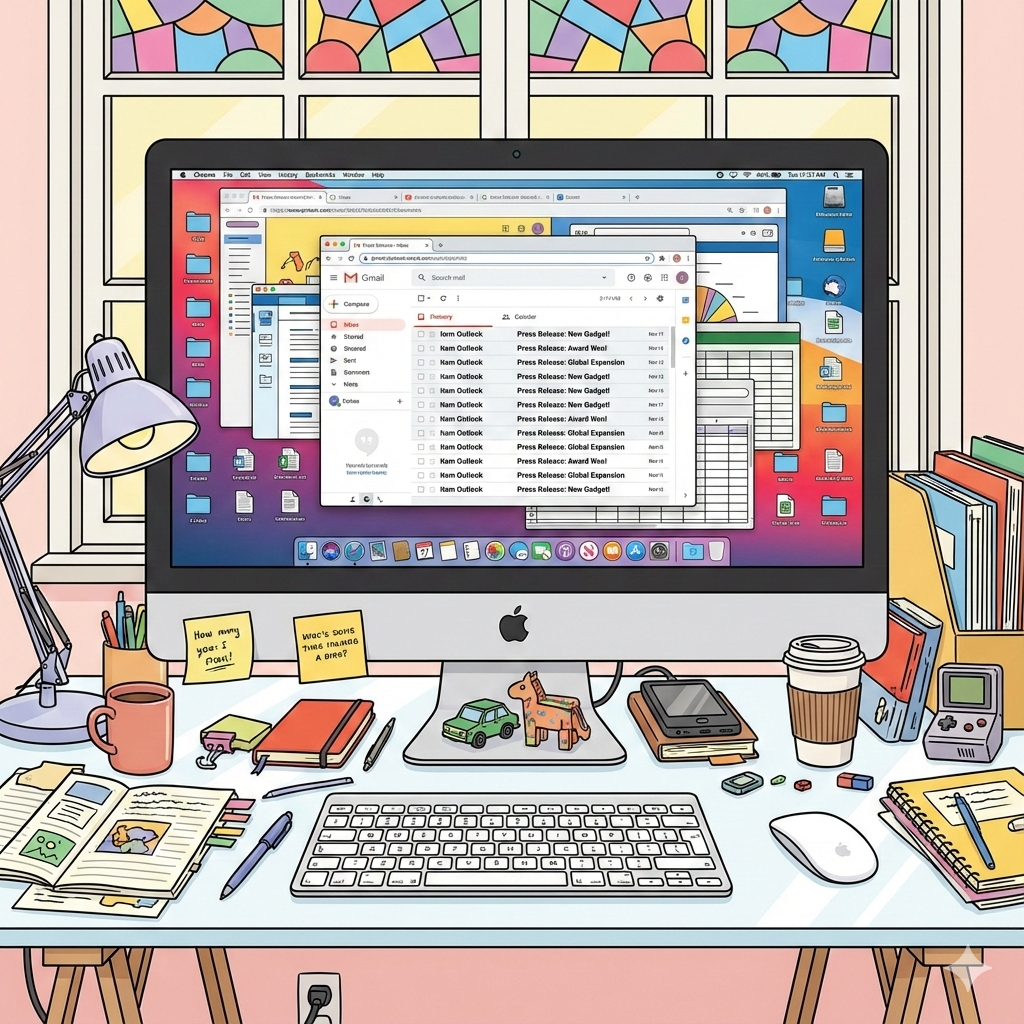
This illustration doesn’t quite capture the scale of the CES press-release takeover on my 27” iMac.
Every January, CES (the Consumer Electronics Show) takes over Las Vegas — and my inbox.
Last year, in the weeks leading up to the show, press releases arrived in a steady stream that quickly became a torrent. For CES 2025, I received well over a hundred pitches. As a writer, creator, and lifelong learner, I genuinely want to discover innovations that are offbeat, curious, or quietly meaningful — the kinds of stories readers enjoy.
But this volume creates a problem.
Last year, I was short on time. I was skimming, deleting, and moving on, all while knowing I was probably missing something interesting. Worse, the process caused a constant, low-grade anxiety: What if the best story is buried in here somewhere?
Complicating things further, I was also dealing with a personal emergency. I didn’t have the bandwidth to manually sift through everything — and I knew I needed a better system.
So, I turned to ChatGPT. Not just as a chatbot, but as a virtual research assistant I jokingly call “Chad.”
What followed changed how I approach CES — and any overwhelming information flood.
Step 1: Crunch Time — Getting Organized (Finally)
If you haven’t used an AI assistant this way before, CES season is a perfect moment to try.
Exhibitors invest heavily to attend CES, hoping for press coverage, mentions, or at least a conversation. Some pitches are thoughtful and compelling. Many… are not. Sifting through them manually to decide what’s worth pursuing is tedious and time-consuming.
That’s exactly where an AI assistant can help.
Rather than reacting emotionally to the flood, I decided to build a repeatable system for evaluation — one that would let me move quickly without missing the signal in the noise.
Step 2: Building a Framework for Evaluation
To help ChatGPT assist me effectively, I created a clear structure for reviewing each pitch. Whether I pasted individual emails or uploaded batches at once, I asked it to assess the following criteria:
Venue and Booth Location Where would the exhibitor be located? A niche startup area like Eureka Park, or a major hall with established players?
Sector What category did the product fall into — AI, mobility, health tech, sustainability, education, or something else?
Innovative Angle Was this genuinely new, or just a repackaging of something familiar? Did it solve a real problem?
Consumer Appeal Would this resonate with everyday users, or was it designed for a narrow professional audience?
Logistics Were booth numbers, demo times, and press invites clearly stated and actionable?
I uploaded emails in batches and let ChatGPT do the heavy lifting — summarizing each pitch concisely, flagging missing information, and highlighting potential standouts.
(As an aside: it’s astonishing how many exhibitor emails omit basic details like venue or booth number. Truly bonkers.)
Step 3: Panning for Gold
Once the summaries started rolling in, patterns emerged.
From wearable AI wristbands and gamified education tools to sustainable tech and even stringless guitars, I began pulling the top two or three candidates from each batch. I then asked “Chad” to compare themes across sectors and organize everything into a working matrix.
That matrix included:
Company name
Product category
Venue and booth number
Core innovation
Why it stood out
This gave me something I’d never had before: a bird’s-eye view of CES. Instead of reacting to noise, I could see where fresh ideas were brewing.
Step 4: The Final Stretch (and Cross-Device Flexibility)
With my flight approaching, I did a few final reviews on my phone, feeding new summaries into the system. Later, back at my computer, I asked ChatGPT to update the matrix with the latest insights.
This is where AI tools really shine: they’re fluid. I could pause, resume, refine, and synthesize — without losing momentum.
Most importantly, I felt calmer. I wasn’t drowning in information anymore. I had a capable research assistant working alongside me.
What Rose to the Top
Here are a few of the less-conspicuous discoveries that surfaced through this process — companies I might have otherwise missed:
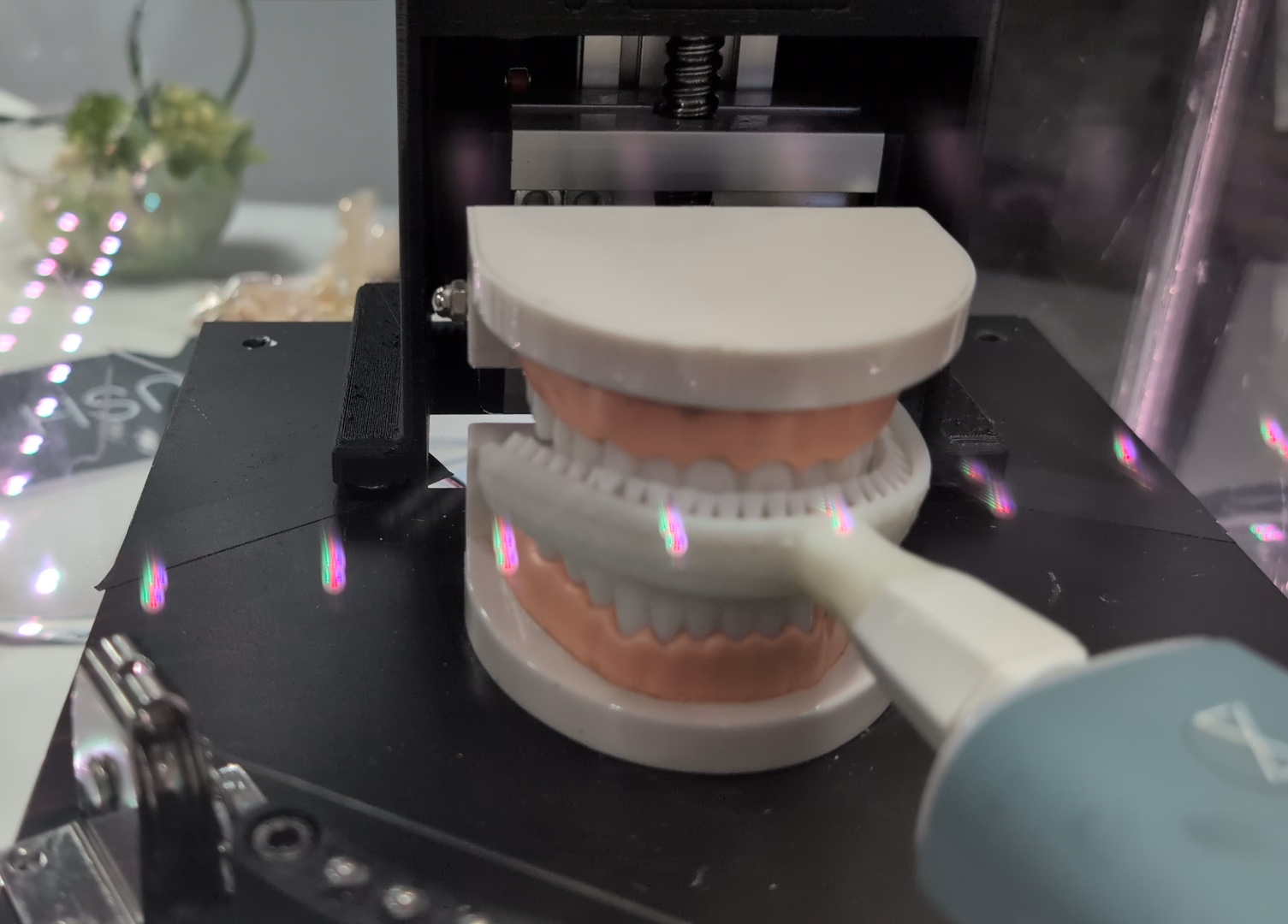
Y-Brush
A 20-second toothbrush with medical backing and a unique design. I found it strange and compelling enough to consider an interview. Ultimately, the design didn’t win me over, so I passed — but they’re debuting a new product at CES 2026, and I’m curious to see what’s next. Website: https://y-brush.co/
(I’ll admit it: I’m a brushing fanatic, and this one didn’t quite do it for me.)
Urtopia E-Bike
Featuring one of the world’s lightest, torque-dense motors and an AI-powered riding assistant. Once on the show floor, I found the bike visually impressive — though I couldn’t connect with anyone for a deeper conversation.
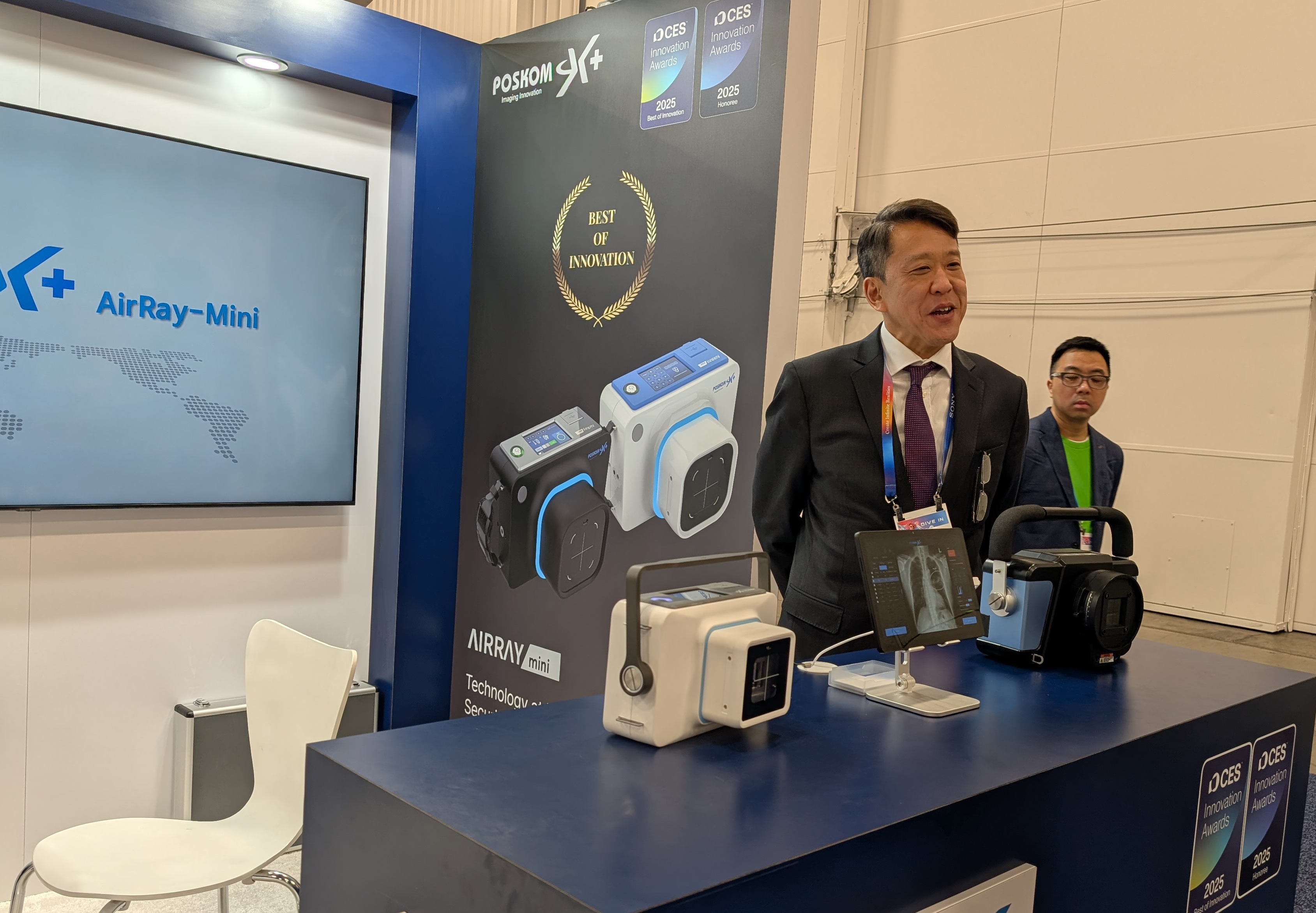
POSKOM
A standout in medical technology, POSKOM produces high-quality diagnostic X-ray systems, including portable battery-powered models used in both medical and veterinary settings. This exhibit exceeded expectations and went on to win a CES 2025 Best of Innovations Award. Website: 🔗poskom.com
I met Eugene Lee before the show and came away impressed by both the products and the team.
LiberLive Stringless Guitar
A sensory-based music innovation that immediately sparked curiosity. A stringless guitar? Why — and how? It struck me as a playful way to enable aspiring musicians. Website: 🔗 liberlive.com
Suzie Cruz demoed the Liberlive stringless guitar. I thought it might interest a friend who plays in a classic rock band, The Kingsmen.
Kara Water
One of my favorite stops at CES. Kara Water solves a real problem — access to clean, fresh water — with a simple yet powerful idea. It’s the kind of innovation that feels both practical and quietly inspiring. Website: 🔗 karawater.com Note: Earlier post about Kara Water: https://terri-nakamura.com/2025/10/30/turning-thin-air-into-hope/
None of these were the biggest names at CES. But they sparked curiosity, addressed real-world problems, or simply made me smile — which is exactly what I hope to find.
Extra Ways to Use AI for Sorting and Decision-Making
CES isn’t the only place this approach works. If you’re facing a mountain of information — emails, articles, pitches, or research — an AI assistant can act as a co-pilot. Here are a few additional techniques:
Tagging and Categorization Ask it to assign categories or themes (AI, sustainability, health tech).
Priority Ranking Have it rank items based on custom criteria like relevance or impact.
Summary + Sentiment Pairing Generate one-sentence summaries and assess tone or clarity.
Matrix Building Create structured tables with venues, features, timelines, or costs.
Comparative Analysis Identify what makes one option stand out within a crowded category.
Drafting Follow-Ups Use it to prepare interview questions or outreach emails once priorities are clear.
These techniques apply to job searches, vendor comparisons, research projects, or even travel planning.
What I Learned (and What You Can Too)
If you’re attending CES — or dealing with any kind of information overload — ChatGPT and similar tools can be more than a novelty. They can become genuine productivity partners.
🧠 They help you think clearly by structuring chaos
✍️ They support writing, summaries, and comparisons
⏱️ They save time when pressure is high
Most importantly, they help keep your head above water when the flood is rising — much like the weather in Seattle these past few weeks.
Looking down at some of the many elevators in the Venetian Expo (formerly known as the Sands Expo), the location of Eureka Park, the buzzing startup HUB at CES.
Final Thoughts
Whether you’re a journalist, content creator, founder, or simply a curious explorer, your time and energy are limited. Having an AI assistant can help you focus on what’s truly worth your attention — not just what’s loudest.
Am I doing this again for CES 2026? Absolutely. In fact, I can’t imagine tackling another inbox flood without it.
If you’re attending CES this year, I would love to make your acquaintance. I’ve been connecting with some on LinkedIn though I’m not personally acquainted. Real-life will always be my first choice. Please message me and let me know when you’ll be there.
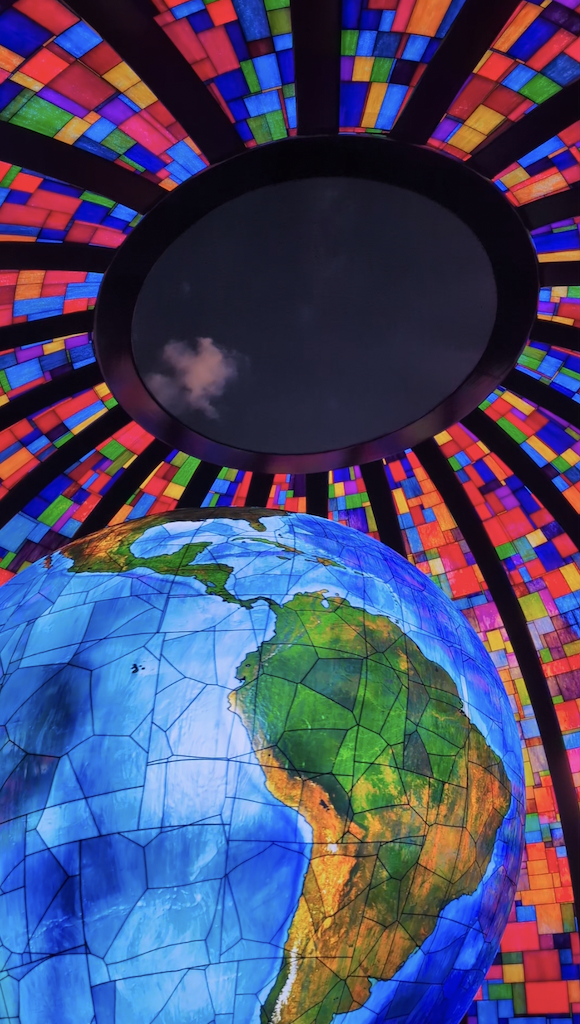
(Photo: Crowd assembling in the Sphere for the Delta keynote presentation, Las Vegas.)
Kara Water is changing how the world thinks about clean water
Every January, I walk into CES with a sense of anticipation that’s hard to describe. Each year, about 140,000 people from around the world arrive to glimpse the future—stepping into a vast, humming, blinking ecosystem of invention where human imagination feels limitless. Advance press releases hint at what’s coming, but I never know what surprises I’ll find. I always come home with stories that remind me why creativity, persistence, and technology are so important.
At CES, there’s a spark that connects everything—whether it’s an IT company like MIXI in Tokyo, manufacturing companion robots for the elderly, or a global brand like Delta Airlines that reminds us even huge innovators often start humbly. Innovation doesn’t wait—and it rarely comes from where you expect it.
Among the hundreds of innovations that caught my eye that week, one stopped me in my tracks: the Kara Pod.
When I met Cody Soodeen, the founder of Kara Water, and his investor, Kerry Dunne, earlier this year at CES in Las Vegas, they stood beside a sleek countertop machine that looked part high-tech gadget and part science-fiction prop. What it did seemed almost impossible: it made pure, mineral-rich water from air.
(Photo: Cody Soodeen, Kara Water CEO, CES 2025, Las Vegas.)
Turning Air into Water
“Water is the most important substance on Earth,” read the Kara Water sign—more truth than slogan. Their device, called the Kara Pod, uses what’s known as Air-to-Water technology. It can produce 3.2 liters of crisp drinking water a day—enough water to brew up to 18 cups of coffee, with no plumbing required.
Imagine a machine that doesn’t run out of water because it creates it.
As I spoke with Cody and Kerry, I couldn’t help but think about a science experiment my friend Linda Criddle does with her summer campers at Little Green Acres Farm in Redmond, WA. She offers STEM experiences, like showing kids how to collect water from the air using two metal bowls—one nested inside the other.
Linda explained, “The core principle is temperature differential. Hot air holds moisture. When the air cools, condensation forms—just like when a cold drink ‘sweats’ on the counter.”
It’s the same principle that Kara Water has harnessed—only their version uses advanced thermoelectric technology to cool air, extract moisture, purify it, and then infuse it with minerals that make it taste naturally fresh.
The Inspiration Behind Kara Water
When I asked Cody what inspired him to create his invention, he said it didn’t start with technology. It started with family.
“It’s a very personal story,” he said. “My parents are from Trinidad. We lived in Pennsylvania and got our water from a well. We thought it was fine—country water, right? But we kept getting sick.”
After endless medical appointments, a naturopathic doctor recommended testing their well water. The results showed extremely high levels of bacteria. “We ‘shocked’ the well, like you’re supposed to, but two months later the bacteria were back,” Cody said. “We were living downhill from everyone else’s runoff, and there wasn’t much we could do.”
The family switched to bottled water, but Cody couldn’t shake the question: Why should anyone have to rely on polluted or unreliable water sources?
Years later, while studying architecture, Cody stumbled upon something extraordinary—a small black beetle that survives in the desert by drinking water from the fog.
“It’s called the Namib Desert Beetle,” he said, eyes lighting up. “When fog rolls in, it climbs up a dune, sticks its legs in the sand, and tilts its body so the condensation runs down into its mouth.”
He smiled. “That beetle changed my life. It lives in one of the driest places on Earth with no energy, no infrastructure—and it still finds water. I thought, If nature can do that, why can’t we?”
Kara Water’s name, he explained, comes from the beetle’s scientific name—Stenocara gracilipes. “The beetle is literally built into our logo,” he said, pointing to the smooth, shell-like symbol etched into the Kara Pod’s design.
(Photo: Kara Pod on display at CES 2025—the world’s first self-refilling coffee maker, generates enough water to brew up to 18 cups of coffee each day.)
A Decade of Persistence
Cody spent nearly a decade turning the idea into reality. “People think of it as an overnight success,” he said, “but it took ten years of learning, experimenting, and failing.”
The company officially launched in 2021 with its first device, Kara Pure, a sleek air-to-water dispenser that makes up to 2.5 gallons per day. The world noticed. Kara Pure earned TIME’s “Best Inventions of 2022” award—the kind of recognition that doesn’t come easily.
Then, in late 2024, Kara Water unveiled the Kara Pod—its next-generation device that not only made water from air but could also brew a cup of coffee using that same freshly made water.
At CES 2025, that innovation earned them another accolade: the CES Innovation Award. And this October, TIME recognized the Kara Pod as one of its “Best Inventions of 2025.”
Kara Water joins an elite circle of fewer than twenty companies worldwide that have appeared multiple times on TIME’s “Best Inventions” list.
Kerry’s Perspective: A Believer and Investor
When I spoke with Kerry Dunne, one of Kara Water’s investors, he sounded like a proud parent.
“There are rivers of water in the air,” he said. “Cody figured out how to capture it—how to make it clean, pure, and drinkable anywhere.”
He described the process: the machine pulls in air, cools it until water condenses, distills it, removes impurities, and then adds in alkaline minerals.
“Alkaline water is the best kind you can have,” Kerry said. “It’s clean, healthy, and tastes fantastic.”
The result is water that feels crisp and refreshing, with no hint of processing or plastic—just pure hydration, straight from the atmosphere.
When I asked how many Kara Pods were out in the world, Kerry surprised me. “We made a thousand and sold out instantly—in 44 countries,” he said. “And there’s a waiting list of 25,000 people.”
That’s pretty impressive.
(Photo: Investor Kerry Dunne at CES 2025, Las Vegas.)
Simple Operation, Global Potential
One of the things that impressed me most was the simplicity. I asked Kerry if it was tricky to use—did it require a manual?
“You plug it in and forget about it,” Kerry said. “It takes about a day to start producing water, and by the next morning, you’ve got your first glass.”
A Kara Pod can generate 3.2 liters of water per day, depending on humidity and temperature. And because it doesn’t need plumbing, it works in cities, deserts, and even off-grid environments.
Kerry told me they’re working on a solar-powered model designed for regions without reliable electricity. “We’ve got them running in Saudi Arabia, Arizona, and all over Africa,” he said. “Everywhere, they make water every single day.”
Clean water shouldn’t be a privilege, and technologies like Kara Water make it easier to imagine a world where everyone, everywhere, can have access to safe drinking water.
From Concept to Connection
Back at the booth, I watched people’s reactions. Some approached with skepticism, others with wonder. A few even tasted the water—clean, mineral-rich, and surprisingly smooth.
“You’ll love it,” Kerry said. “It tastes remarkably like water.”
It was such a simple, funny line—and yet, true.
That’s the paradox of innovation: the best ideas often make us ask, Why didn’t we think of that sooner?
Kara Water’s journey began with a contaminated well in Pennsylvania and was inspired by curiosity about a desert beetle—a path that eventually led to CES—a stage where the world meets technology’s next big leap.
(Photo: Kara Water sample, Las Vegas, January 7, 2025.)
The Science Made Simple
Linda Criddle’s “air-to-water” lesson at Little Green Acres Farm kept echoing in my mind as I viewed the Kara Pod on the exhibit display. Stainless-steel bowls, sweating with dew overnight, are a child’s version of what this machine does with precision and purpose.
Temperature differential. Condensation. Collection. Purification.
The Kara Pod turns those age-old natural processes into something modern, compact, and accessible.
Recognition and Momentum
Since its founding, Kara Water has been gaining attention from major retailers and organizations worldwide. Costco, Walmart, and other large distributors have expressed interest in global partnerships.
But what struck me most wasn’t the corporate excitement—it was Cody’s calm conviction.
Clean water isn’t just a comfort—it’s survival. According to FEMA, having an ample supply of clean water is a top priority in an emergency. A normally active person needs at least two quarts (half a gallon) each day. People in hot environments, children, nursing mothers, and those who are ill need even more.
“We’re just getting started,” Cody said. “Our goal isn’t to sell a million machines. It’s to make clean water possible everywhere. Air is universal—and so should water be.”
Reflections on Discovery
Every year, CES reminds me why I love writing about technology. It’s not just the dazzling displays or the futuristic gadgets—it’s the human stories behind them.
A family’s struggle with unsafe well water. A young architect’s curiosity sparked by a small black beetle. An investor who believes in something that seemed impossible.
And somehow, all of it converges into a device that turns thin air into life.
That’s the kind of story that keeps me coming back to CES. It’s not just about technology—it’s about hope, resilience, and imagination.
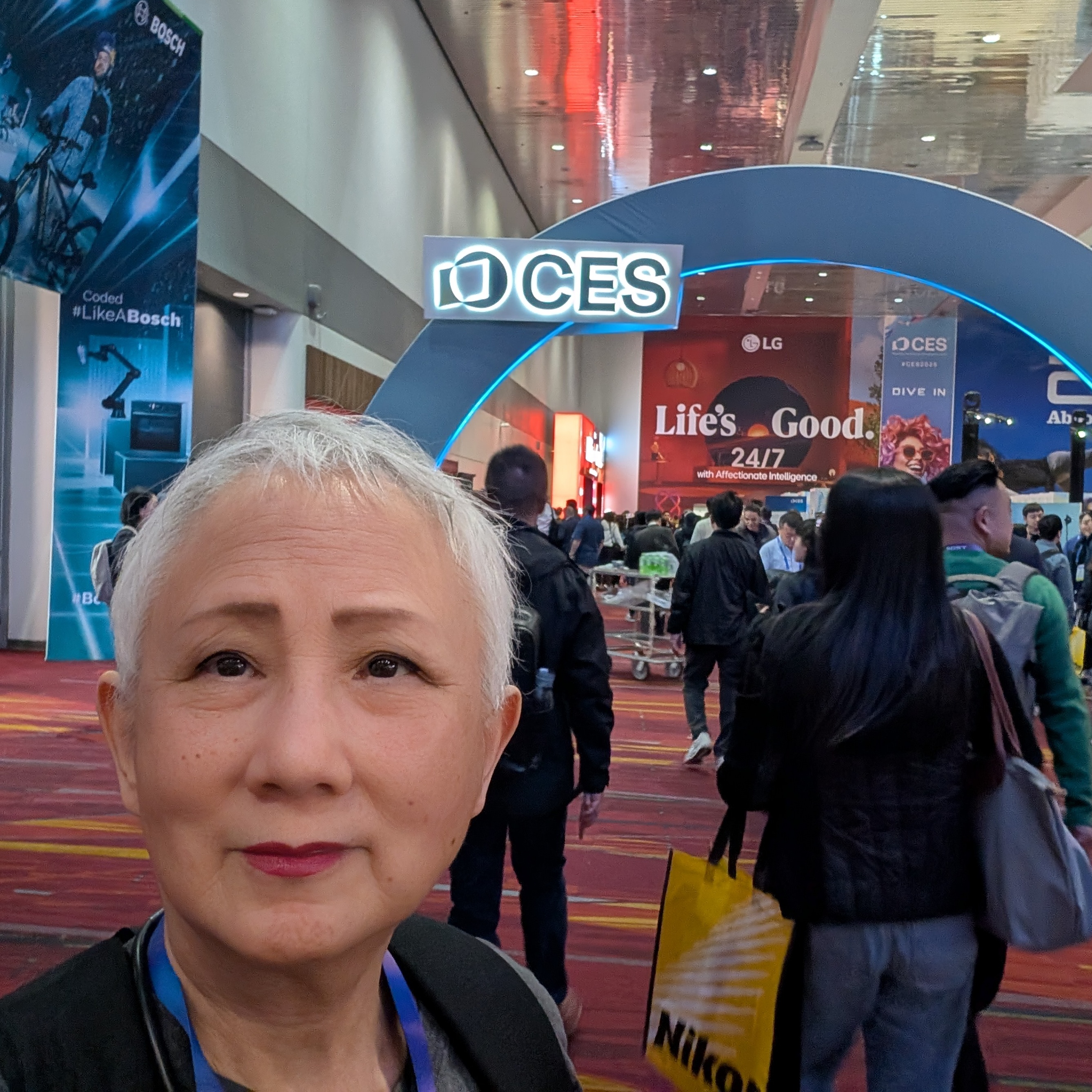
(Photo: Selfie of me at CES 2025 in Las Vegas.)
Looking Ahead to CES 2026
If Kara Water is any indication, the next CES will be filled with even more world-changing ideas, shaping how we move, how we heal, how we communicate, how we power our world, and how we care for the planet.
Innovation doesn’t wait, and neither should curiosity.
CES 2026 happens January 6–9 in Las Vegas. CES is a trade-only event, not open to the general public.
Are you an industry analyst, work in media, or will you attend as exhibitor personnel?
January 7, 2025—The First Day of CES, by Terri Nakamura
An Early Start for the Delta Keynote
Mornings and I aren’t the best of friends, but today was an exception. At 7 AM, I was up and ready to head to the Las Vegas Convention Center (LVCC) West Hall. Why the early start when doors didn’t open until 10 AM? Delta. After missing out on tickets earlier, I wasn’t taking any chances on securing seats for CEO Ed Bastian’s keynote presentation. Adding to the excitement, this year I had my brother Dave with me for his first-ever CES—so the stakes felt even higher.
Navigating Challenges to Secure Tickets
The day started with a detour. Instead of a quick entry with our media passes, we found ourselves on a wild goose chase. The West Hall was open only to non-media attendees, forcing us to trek what felt like half a mile to find an alternative entrance. Inside, we were greeted by an already long ticket line.
Not one to sit idle, I left Dave in line and headed to the information desk. That’s when luck struck. Two women at the desk shared my impatience and suggested starting a second line. We struck up a rapport with the ticketing staff, and in a stroke of serendipity, they agreed to issue us tickets as soon as the desk opened. What could have been an hour-long wait turned into a quick win—proof that “bias for action” and “invent and simplify” truly pay off!
Exploring the West Hall
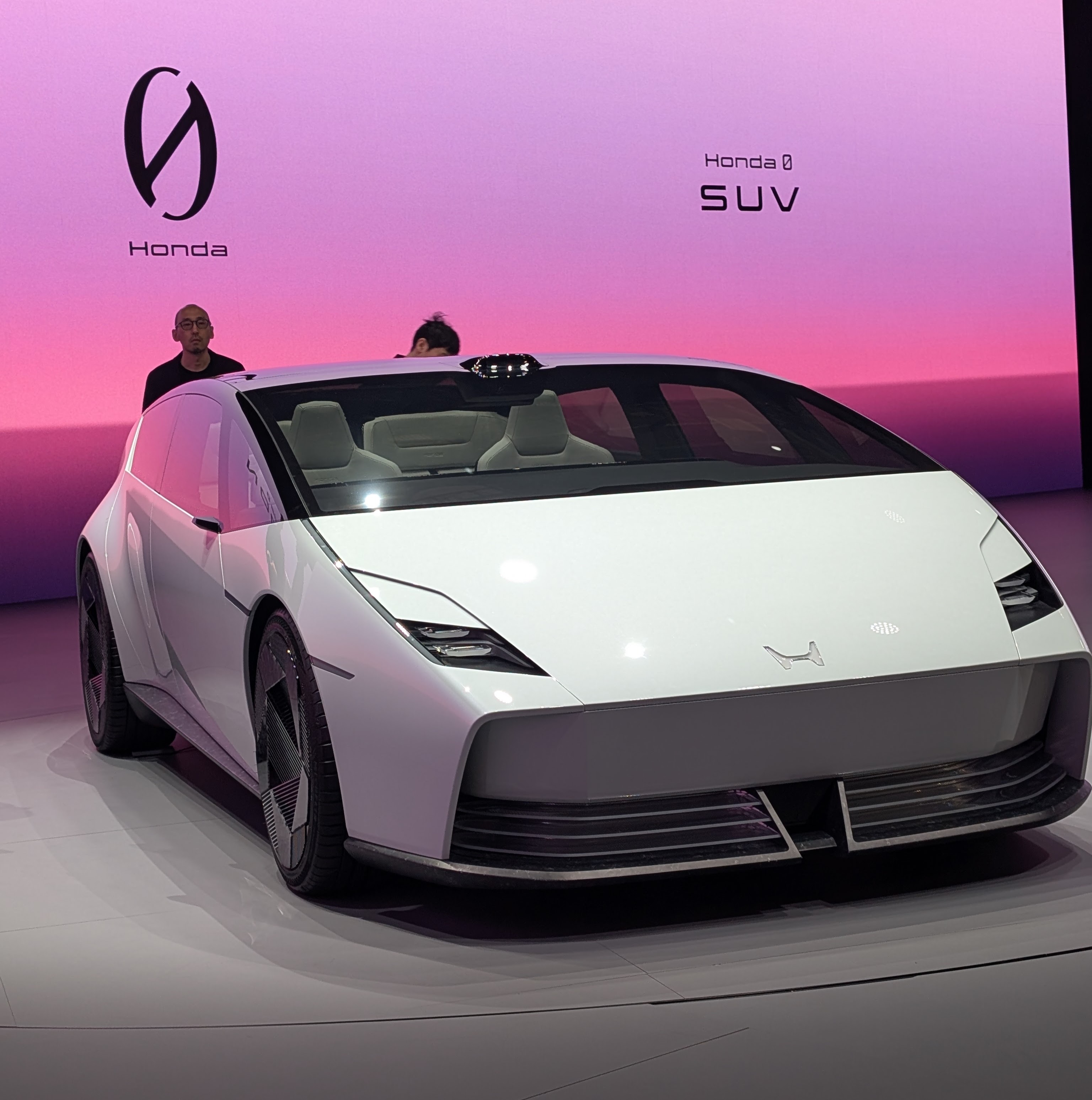
With tickets secured, Dave and I explored the West Hall—a showcase of cutting-edge innovation. Familiar brands like John Deere, BMW, and Audi displayed their latest marvels, while Jaguar leaned on its classic logo (though I prefer the updated design). The standout? Honda’s sleek and stunning Honda 0 SUV.
Traveling Through the Loop and Visiting Eureka Park
Next, we hopped into the Loop—Tesla-driven underground tunnels whisking attendees between halls—and made our way to the Central Hall before shuttling to the Venetian Expo. The buzz of Eureka Park greeted us, a hotbed of global startups. Two companies caught my attention: Kara Water, which transforms air into drinkable water, and Mixi, creators of small, charming companion robots.
The Sphere: A Venue Unlike Any Other
Then came the highlight of the day: the Sphere. Just stepping inside was awe-inspiring. Its sheer scale and the energy of the crowd felt electric, and the state-of-the-art venue itself was a masterpiece. Endless lines reminded me of Disneyland, but the anticipation was worth it.
The Delta Keynote: Innovation and Inspiration
The Delta keynote was nothing short of extraordinary. Ed Bastian’s presentation showcased Delta’s commitment to using technology to forge human connections in the next century of aviation. Leveraging the Sphere’s cutting-edge features—like the Exosphere, the world’s largest LED screen, and HOLOPLOT-powered immersive sound—Delta delivered a sensory-rich experience that set a new standard for CES presentations.
Bastian revealed partnerships with YouTube and Uber, while Viola Davis, Delta’s iconic “voice,” captivated the audience with her poetic reflections on the miracle of flight. Then came the surprise guest: Tom Brady, introduced as a content creator for Delta’s inflight entertainment—a surreal moment for sure!
Lenny Kravitz Brings the Night to a Close
The keynote ended on a high note with a show-stopping performance by Grammy-winning artist Lenny Kravitz. Between free food, drinks, and a swag bag brimming with goodies (sweatshirts, hats, snow globes, and a $20 Uber gift card), Delta raised the bar for CES events. It was easily one of the best I’ve attended.
Final Thoughts: Delta and the Sphere Shine Bright
If you ever have the chance to attend an event at the Sphere, seize it. As for Delta, I wasn’t prepared for such an informative, engaging and impressing presentation. They’ve officially earned my loyalty. After today, they’re my go-to airline for the future.
My name is Terri Nakamura, I’m a graphic designer and writer, and I’ve been a social media aficionado and netizen since the early 2000s. On March 18, 2024, my tweets and connections were rudely hijacked, and I was shocked to discover that hackers had stolen my paid “Twitter Blue” @terrinakamura Twitter/X account!
Has this happened to you or someone close to you? It’s worrisome, time-consuming, and, in my case, incredibly frustrating.
Since March 18, I’ve been trapped in a never-ending nightmare, fighting through countless support requests and presenting a mountain of evidence to Twitter. I’ve shared receipts of my payment for Twitter Blue, selfies, a barrage of links and screenshots, and official “Twitter” scans of my legal ID – all hoping to prove my identity and ownership. But Twitter remains unconvinced, and it’s been unbelievable and disheartening.
If any of you know a human being employed by Twitter, or maybe someone who USED to be employed before (according to CNN) Elon Musk fired 6,000 people, I would be beyond grateful to talk with someone who could shed light on this insanity.
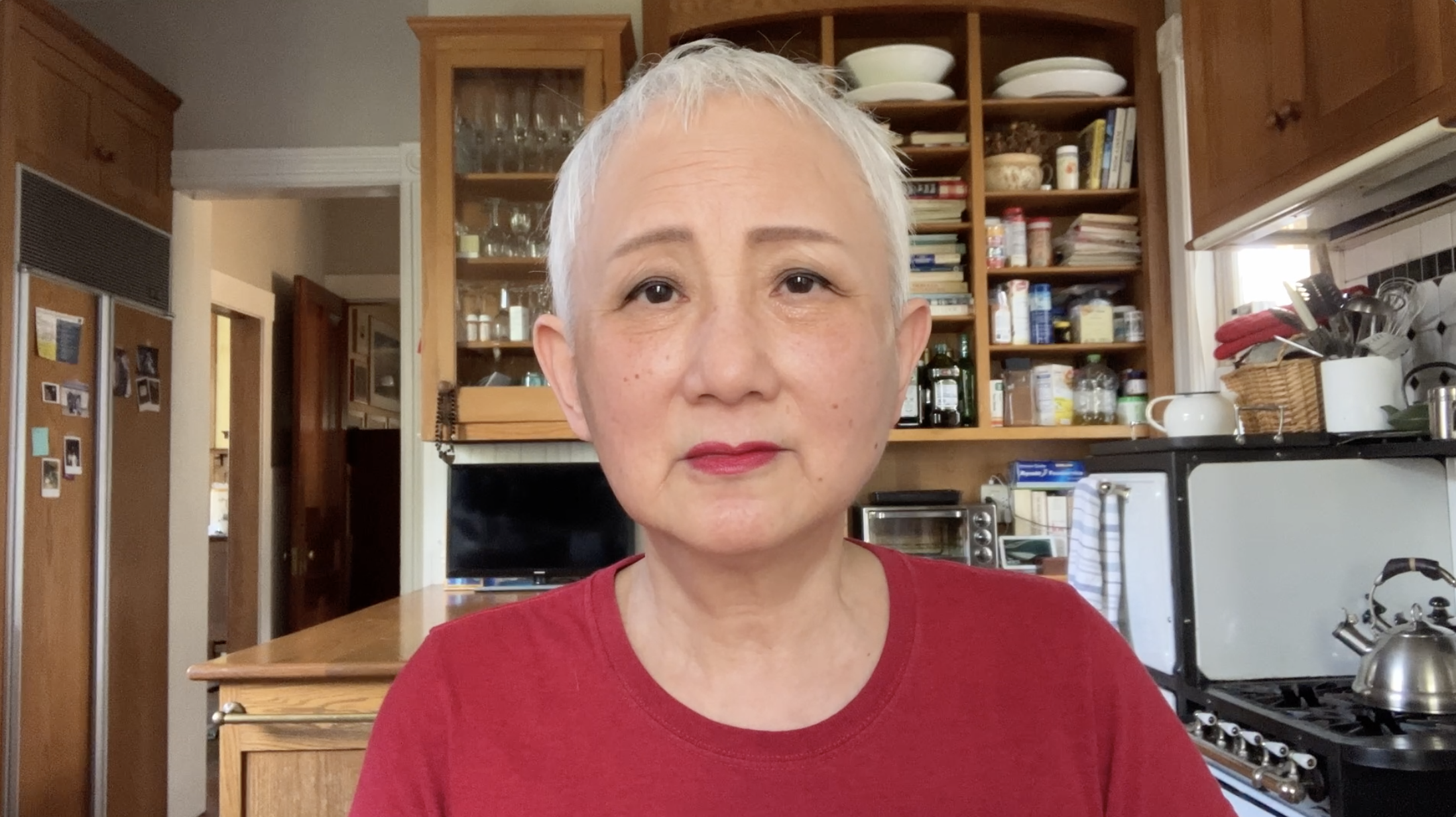
Out of sheer desperation, I did something I never thought I would – I recorded a video of myself speaking. I did this to share my story and the frustration I’ve been experiencing, hoping that it might resonate or inspire someone to help.
I’ve been a podcast interview guest with Neal Schaffer, Tim Hughes, Rod Jones, Avery Nishimura, Begoña Pino, Julian Leahy, and others. For me, it’s much easier to answer questions than to just talk by myself. I’d been thinking of posting a YouTube video, and today, I finally sat down and made one. I wish I’d spent more time making myself look presentable, but oh, well. I gathered a few visual props and turned on the camera. I didn’t rehearse, and it was done in one take, with imperfections and all.
The Seattle PD and the Washington State Attorney General have taken up my cause, stepping up to help me reclaim what was unjustly taken from me. Both take identity theft very seriously, wheras Twitter doesn’t. But still, the hackers remain at large, enjoying the show from their parents’ basement.
Have any of you experienced this level of frustration when regaining access to a hacked account? I’ve been told LinkedIn and META are much better neighborhoods when it comes to keeping users safe from account theft. Were you able to resolve the issue? If so, could you please share your story with me?
Your assistance could make a difference, and I will be forever grateful for any help you can provide.
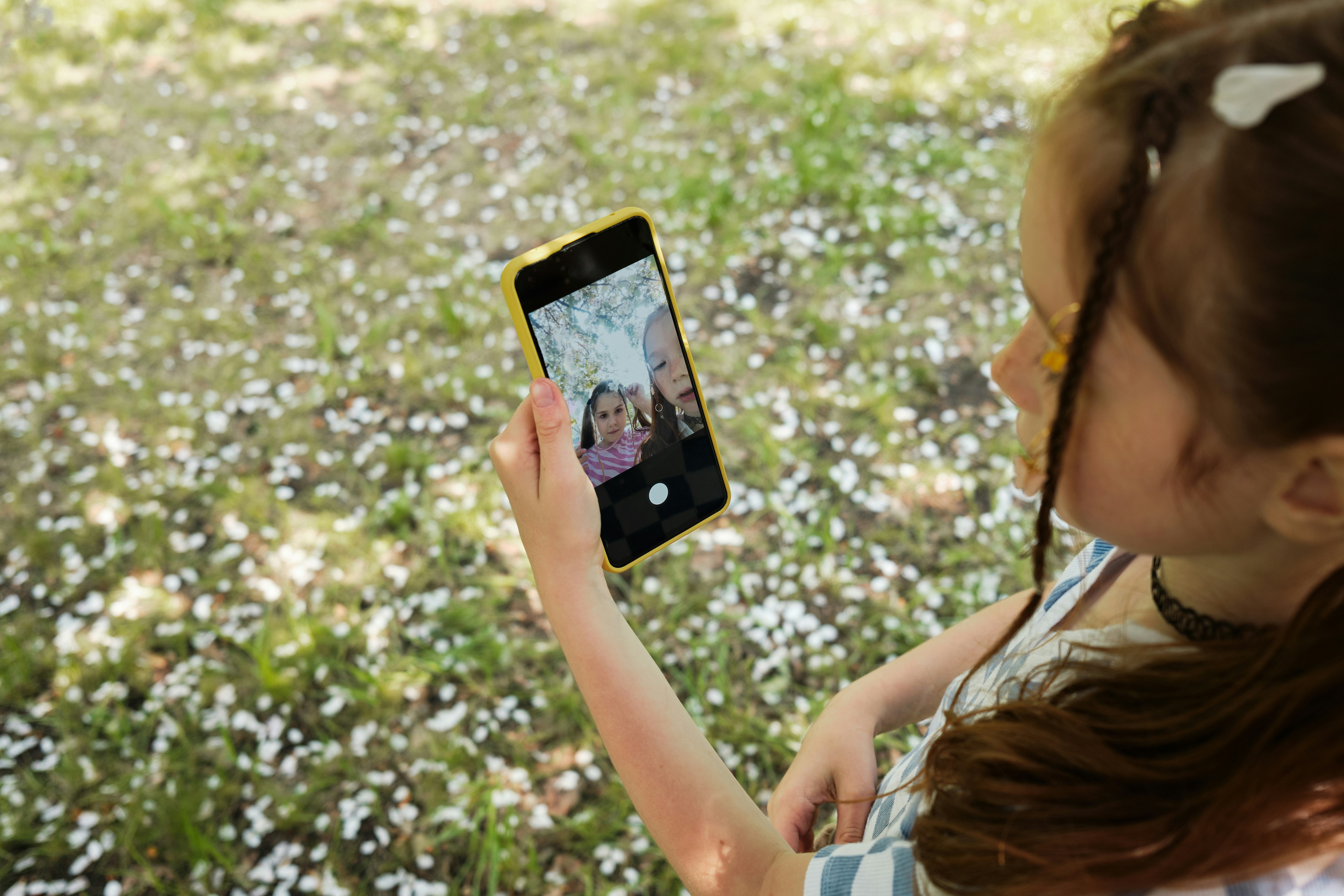
Keeping kids safe on social media. Photo: Unsplash with Andrej Lišakov
Social Media’s Impact on Kids – What’s Next for Tech?
During my four days at the Consumer Electronics Show (CES), I had the opportunity to attend only one panel discussion. I’m grateful that I chose to listen and see this particular one in person.
A lengthy queue of eager attendees had formed, all looking forward to hearing insights from the three distinguished speakers, including Mitch Prinstein from the American Psychological Association (APA), Megan Jones Bell from Google, and Ravi Iyer from the USC Marshall School’s Neely Center. The panel was expertly hosted by Corbin Evans, Senior Director at APA.
While my own children are now adults, I find myself thinking about the impact of electronic devices and the potential repercussions of allowing young children access to social media platforms. This concern has taken on a greater significance since I’ve become a grandparent.
The dynamics of social media engagement are vastly different for adults compared to the experiences of children and teenagers. Most adults, myself included, can navigate platforms like Instagram without getting caught up in the potential negative experiences. My personal journey with social media journey dates back to the early 2000s and I’ve been fortunate to encounter very few negative incidents. This contrast underscores the importance of distinguishing between adult, adolescent and pre-teen use.
In sharing this summary, my hope is that it sparks interest among parents, educators, and all who share concerns regarding the profound influence of social media on our kids. It’s a topic that deserves our collective attention as we seek to safeguard the well-being and development of younger generations.
Mitch Prinstein, Ph.D., Chief Science Officer, APA
Mitch Prinstein asked the question, did problems get worse when social media began? He talked about the lack of specific data that correlated between social media and negative effects on mental health including suicide, weight gain or substance abuse. They’re unable to say the current youth mental health crisis has been caused by social media.
When kids are asked, they report a wide array of reasons that affect their mental well-being, such as school shootings, exposure to violence and sexual assault, unrealistic academic pressures, increased polarization, climate change and leadership critique of underrepresented identities. These things exacerbate the current situation, but none are the singular cause of the current mental health crisis.
Image: Mitch Prinstein, APA
It’s important to consider that the adolescent brain isn’t fully cooked, and that teenagers and their developing brains are affected by social media. Even though these platforms were made for adults, kids use them instead, and especially when their brains are changing the most.
During this time when the adolescent brain is changing, the rapidity of change is second only to the changes during the first year of life. The first area of the brain that changes is the part that makes kids roll their eyes, especially at their parents. Prinstein says it’s because of the proliferation of dopamine and oxytocin receptors in an area called the anterior cingulate cortex.
Graphic: Mitch Prinstein, APA
They suddenly become very sensitive to what their peers think, and very interested in avoiding anything that could cause them harm or a social consequence. This is happening around the age of 10, 11, 12 when there is a hyper-charged desire to connect with peers.
Not many years later, we see the full capacity of the pre-frontal cortex, the last area of the brain to develop, which is like the “brain’s breaks,” or the inhibition center that stops people from pursuing every impulse they have.
Between the ages of 10 and 25 is when we see the most social media use. A lot of kids are getting their phones at the time when they’re desiring so much interaction with peers. And they’re unable to stop themselves from the hyper engagement with social media platforms for many years to come.
What Scientists are Asking
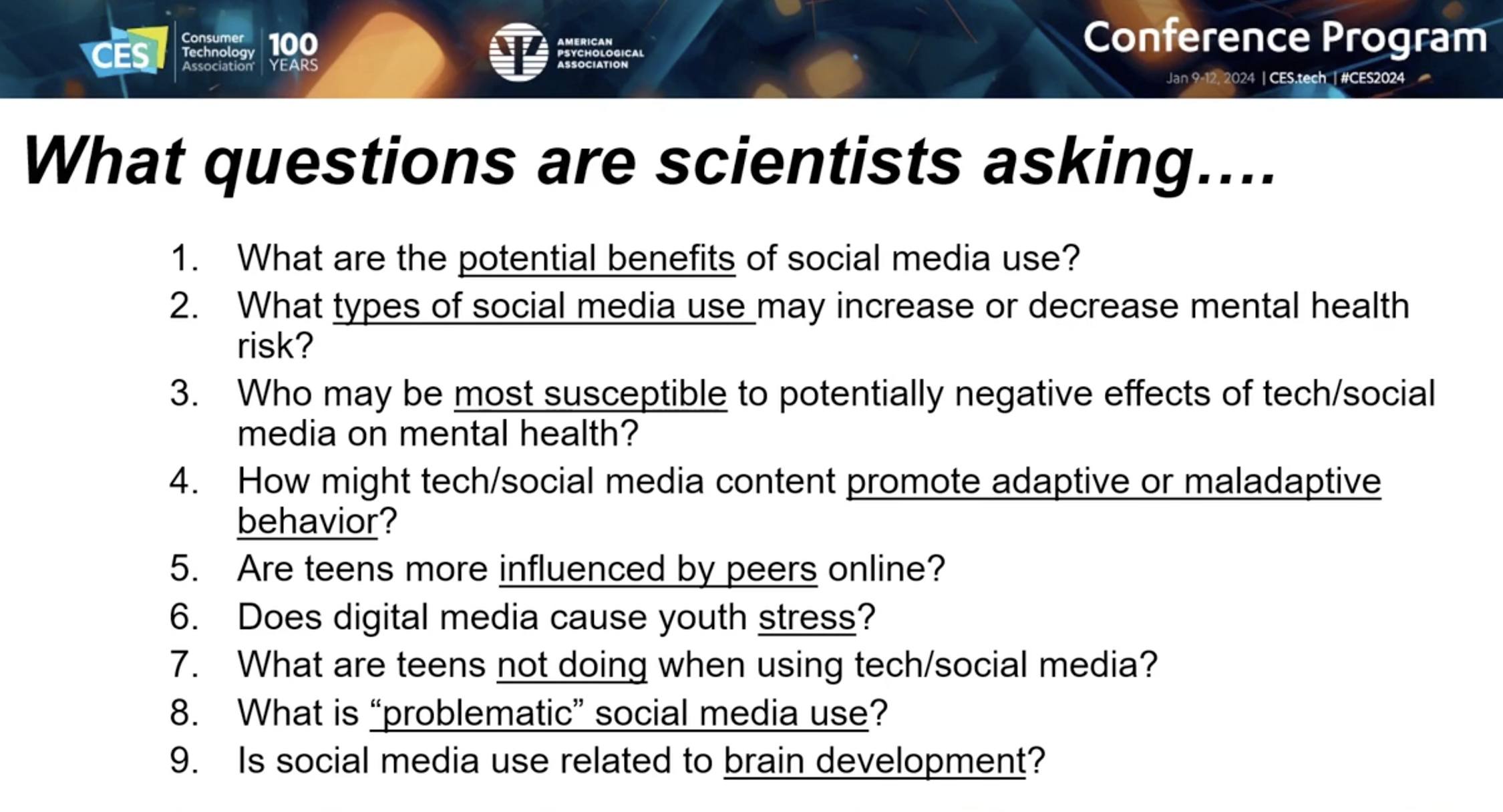
Scientists don’t usually ask if social media is all good or all bad. The scientific community is asking a variety of other questions to try to understand the effects of digital media on adolescent development. In what ways is social media benefitting or fostering the development of important competencies or relationships?
What are the ways kids are showing problematic effects of social media use, like addiction? What are the opportunities that kids miss each minute they’re on social media, like sleep and exercise? What ways are kids more susceptible to misinformation?
Overall, when we talk about social media, there are 3 separate aspects.
Content on SM that kids generate, seek out, or things that are presented to them
Specific features of SM, the “like button, the endless scroll, the follower counts — these are things that are new and different and change our social relationships.
The AI piece, which is new and evolving, and we know less about.
Parents wonder how much time their kids should spend on social media. If they’re reading the New York Times and talking with their friends about political issues, maybe 20 hours a day? joked Prinstein.
But if they’re on SM and being directed to content on how to cut themselves and how to keep it from their parents, less than a minute would be too much.
We have to think about ways of building competencies that could help their development.
10 Recommendations for Parents, Platforms and Policymakers
Build and encourage use of functions that promote socialization
Tailor platform design, functionality, and permissions to developmental capabilities
Monitor use for early adolescents
Remove content and mininimize exposure to content that promotes illegal or psychologicall maladaptive behavior
Remove content and minimize exposure to content that promotes prejudice, hate or cyberbullying
Routinely screen for signs of problematic use
Limit use that interferes with sleep and physical activity
Limit use that encourages social comparison
Precede use with training teens in social media literacy
Provide resources for continued research on the positive and negative effects of social media on development.
(Excerpted from the graphic below.)
Graphic: Mitch Prinstein, APA
Our recommendations are reflective of a scientific perspective, on how social media can be used to foster healthy and adaptive social milestones, but we need parents to be monitoring social media use. Not looking over their shoulders, but to talk with their kids about what they’re experiencing on social media.
We’re asking tech companies to really think about the adolescent brain and its unique vulnerabilities and capabilities, and to think about making the experiences of an 8 year old on social media different from the experience of an 80 year old on social media. We’re looking at different ways to screen for problematic use, we’re calling for a take down discriminatory and harmful content — content that encourages maladaptive or psychiatrically disordered behavior.
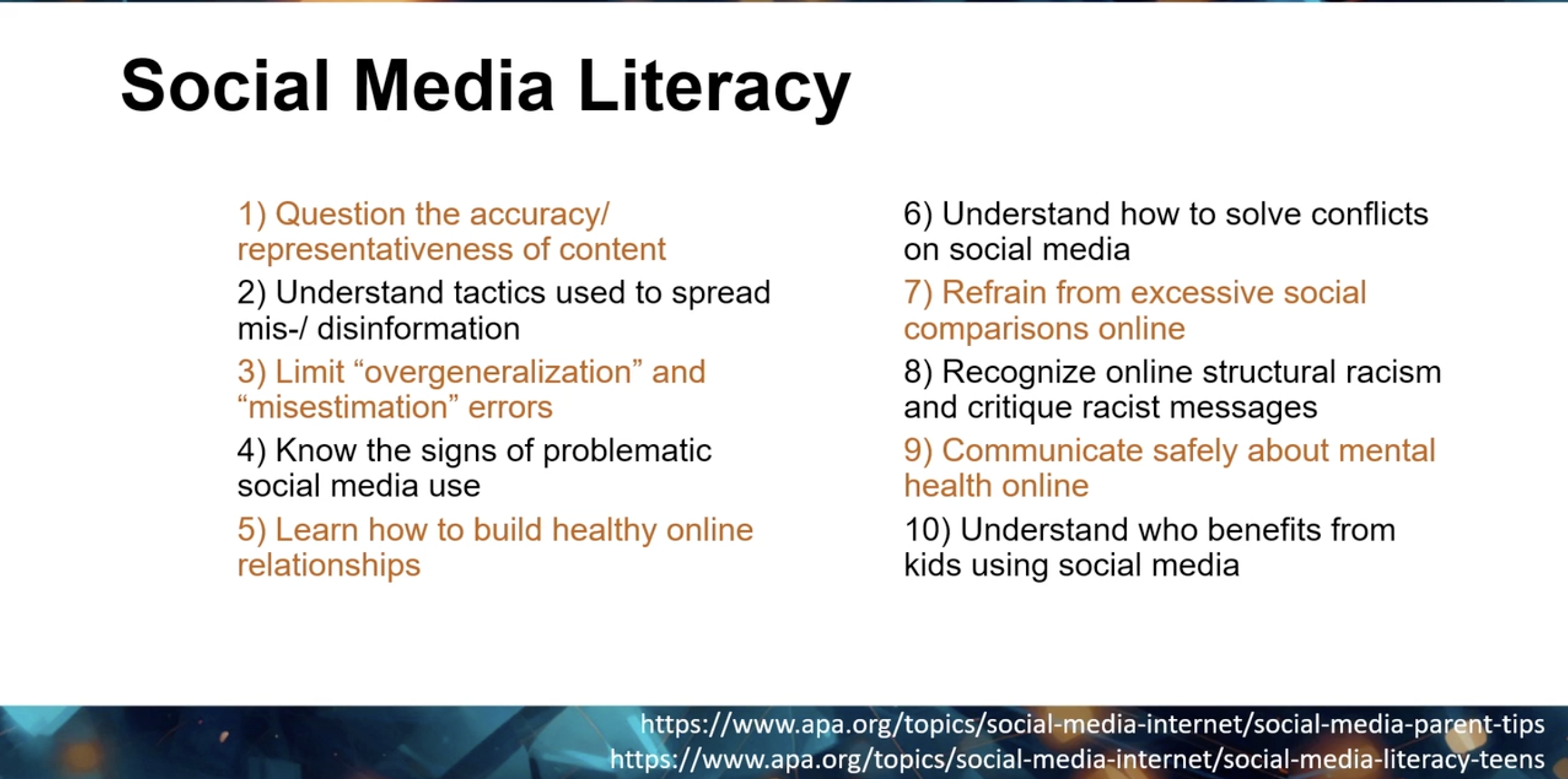
In particular we’re interested in fostering a conversation around social media literacy. We don’t just give kids the keys to a car and wish them luck as they head down the driveway. We make sure they know how to operate a car in a way that would be safe for themselves and others. With social media, there are no tests to demonstrate that they have the competency to understand fake profiles, mis- and disinformation, how to combat cyber-hate and how to engage in adaptive ways of solving interpersonal conflict. This is based on psychological science. Psychologists have developed interventions to teach kids these skills effectively, so we have those tools. It’s time to bring them to scale.
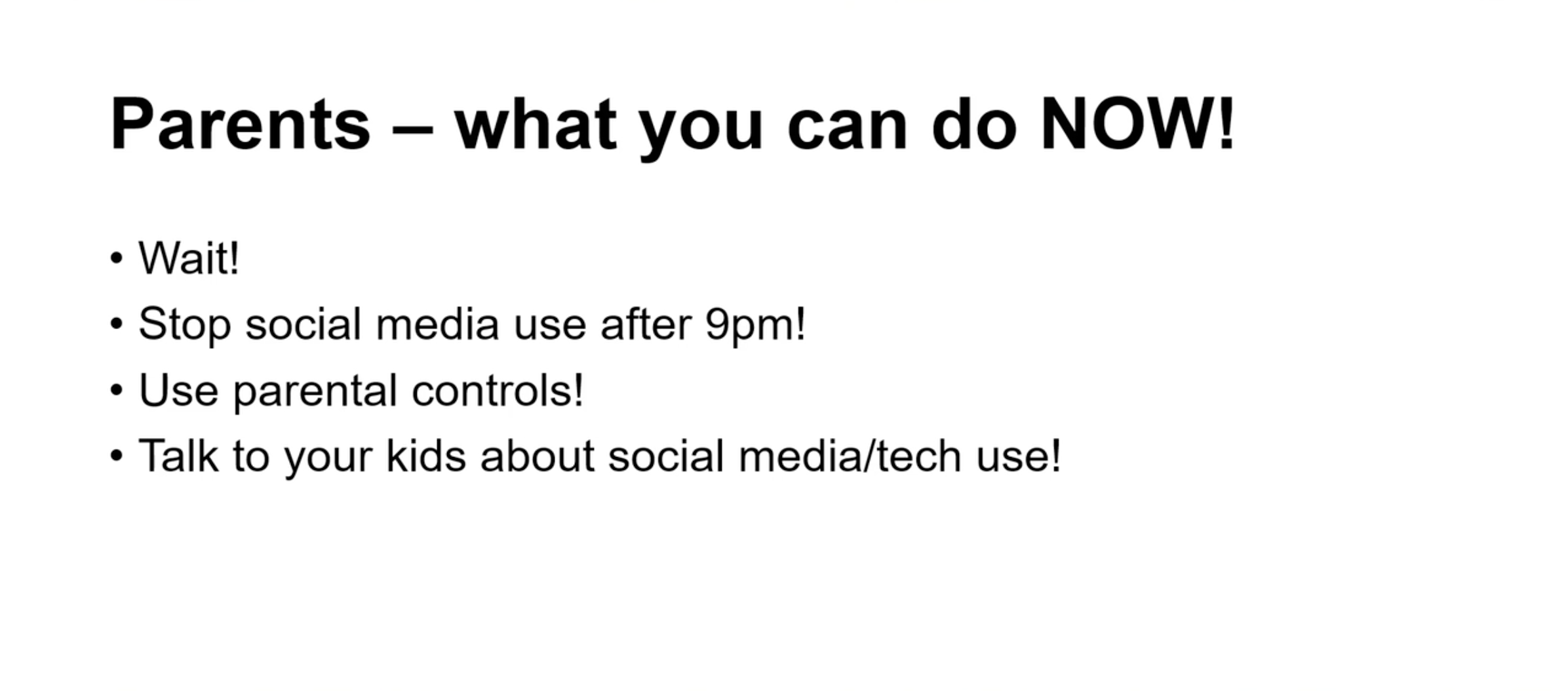
Parents can do so much in this space. There is no psychological science that shows kids are harmed by NOT being on social media. We can stop social media use after 9 PM, use parental controls, and build social media competency.
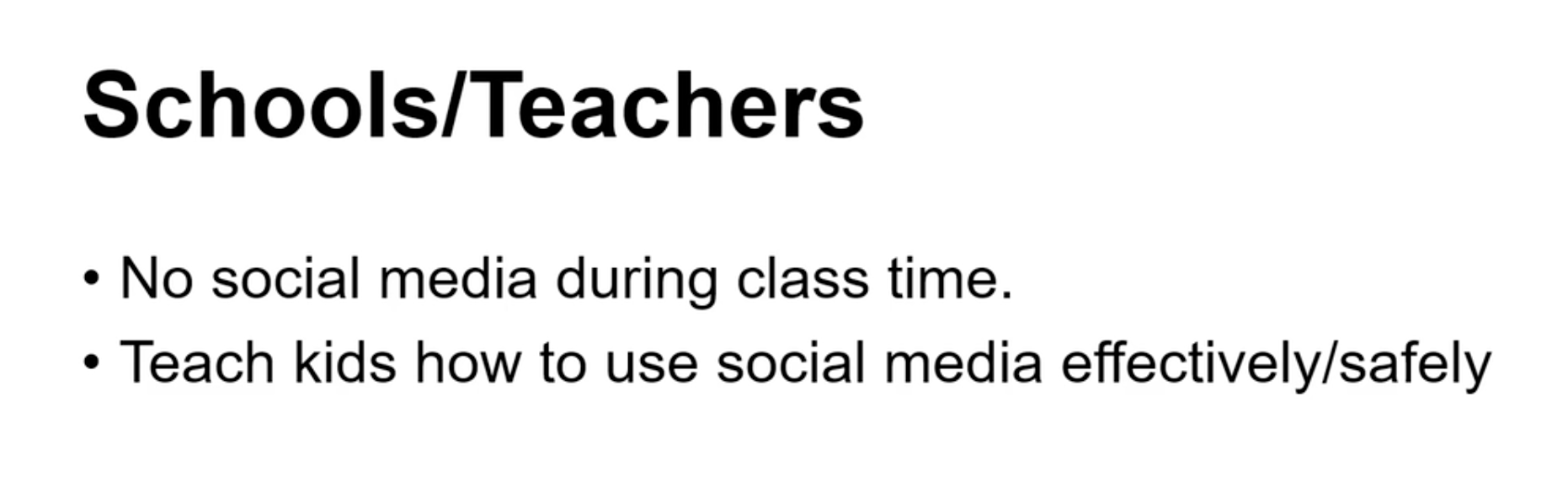
Prinstein suggested that social media should not be allowed during class time, and that schools/teachers should be teaching kids how to use social media safely, and that educators should be teaching kids about the online world. (My note: I’m not an educator, but I have an issue with integrating social media into schools. I see teachers as being burdened with integrating societal changes, which has had a significant impact on their work, and I doubt that educators have the capacity to handle “one more thing.”)
We need to get lawmakers to make sure that kids and their data are protected and we’re not sacrificing their development to help others make a profit.
And we need the tech industry to think of ways that they can put child safety over the model of increased and constant engagement. There are ways this can be accomplished, and that’s what we hope for.
Megan Jones Bell, PsyD, Clinical Director, Consumer and Mental Health, Google
Megan Jones Bell leads consumer and mental health across Google. She shared an overview of how Google approaches the objective of keeping kids and their mental health in the spotlight, highlighting their work on YouTube.
Google is all about creating online experiences that empower kids. Its goal is to provide enriching, safe, and age-appropriate online spaces that respect children’s unique needs while giving families control over technology. Jones Bell said Google builds these experiences with safety in mind from the start, and she shared some recent work done on YouTube, although the efforts extend across Google products.
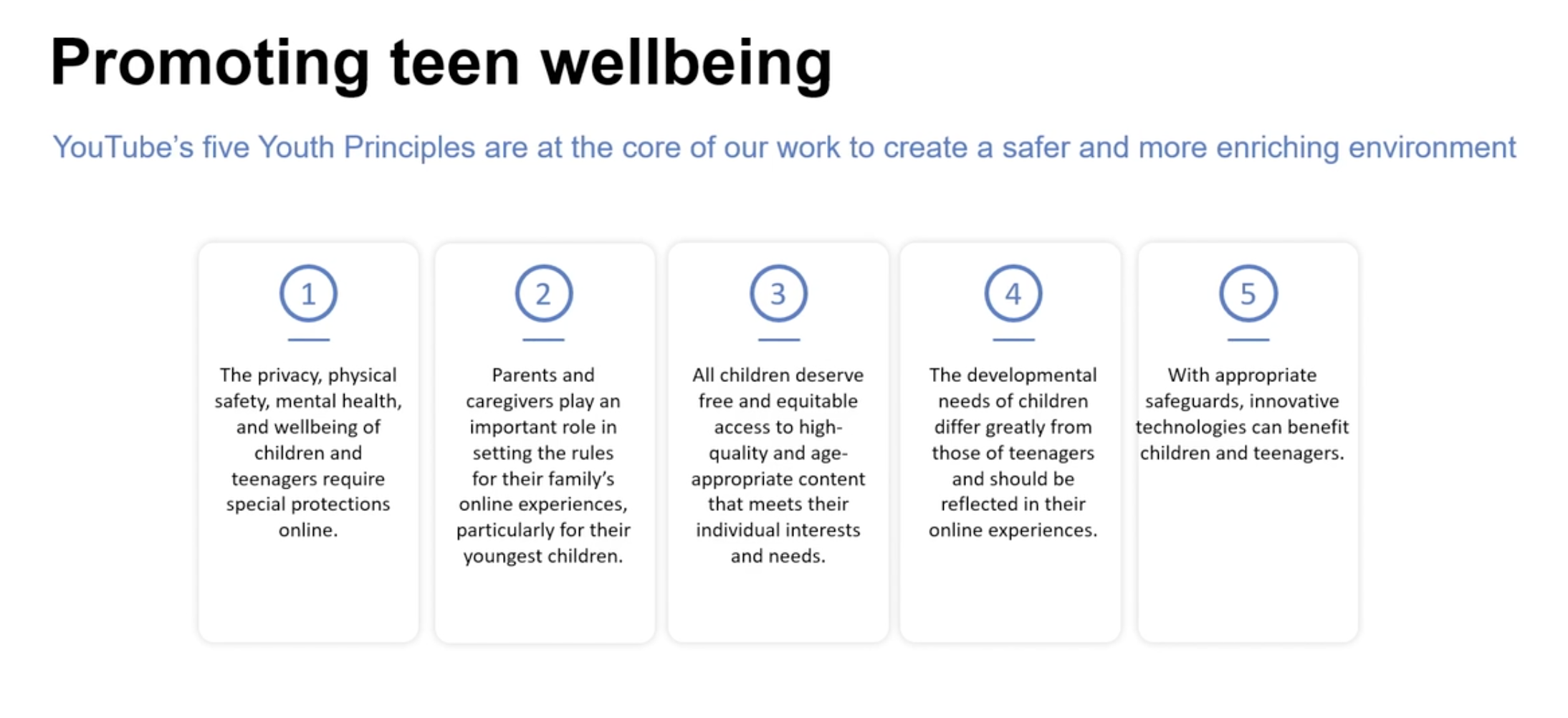
Jones Bell focused on recent work they’ve done on YouTube. Kids’ mental health, which requires special protection online. They’ve developed 5 Youth Principles that form the core of the work that Google does to create a safer and more enriching environment.
Image: Megan Jones Bell, Google. (Excerpt from graphic, below)
Kids’ mental health requires special protection online
Parents and caregivers should have a say in how technology is used within their families.
Every child deserves access to high-quality, age-appropriate content that suits their interests and needs.
Developmental needs of children differ from teenagers’, so tech should reflect that.
With the proper safeguards, kids can benefit from and use innovative technologies.
Google has already introduced features like “take a break” and bedtime reminders in many Google products, but they’re enhancing them to be more effective by creating moments for pause and reflection.
Image: Megan Jones Bell, Google
One thing they’re about to roll out is an all-screen takeover (third panel). These will be more disruptive and create more moment to pause which we know is more likely to get someone to disengage.
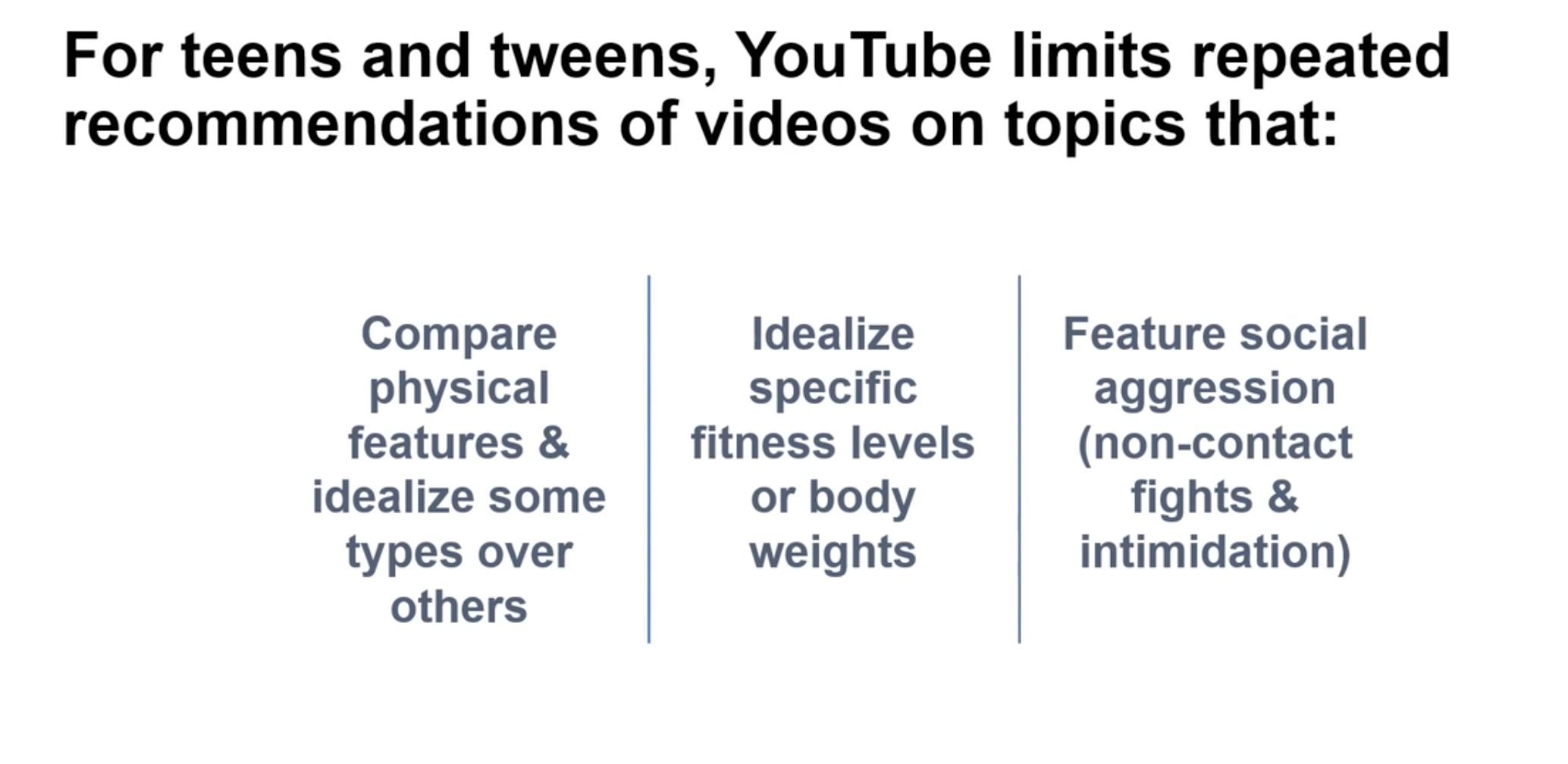
They’re also changing the way they recommend content by focusing on limiting repeated suggestions of videos that might promote unhealthy social comparisons or social aggression among young viewers. They’ve been eliminated from the “watch next” algorithm on YouTube.
Image: Megan Jones Bell, Google
Google wants to ensure that the content they suggest is safe and positive. To support users during difficult moments, they’ve updated their crisis resource panel to encourage safer searches and offer crisis resources more prominently. (It was a small blue bar in its earlier iteration, but the new “pause” page on the right, is a full-screen takeover.) This way, people are more likely to find help when needed.
We know from our research that slowing people down in moments of crisis will lead to disengage from problematic search.
Image: Megan Jones Bell, Google
In terms of promoting high-quality health information, they’re working to elevate high-quality mental health content for young teens by collaborating with experts at the National Academy of Medicine and organizations like the World Health Organization. They’ve also partnered with Common Sense Networks to provide training and resources for creators, helping them make responsible and helpful content and promote digital well-being. These are just some steps they’re taking to create a safer and more enriching online environment for kids and teens.
Image: Megan Jones Bell, Google
Ravi Iyer, Managing Director of the USC Marshall School’s Neely Center
Ravi Iyer was present to discuss how we can design social media to have a positive impact on mental health. While social media isn’t solely responsible for mental health issues, there are ways to make it better for those who are affected negatively. Here are two key takeaways:
Platform Accountability: We should hold social media platforms accountable for their design choices, not just the content they host. Creating spaces that discourage harmful activities and incentivize positive ones is essential.
User Experience Surveys: We can use surveys to gauge user experiences and validate whether platforms improve their design. By listening to users’ concerns and feedback, we can ensure that the changes implemented align with their needs.
During his time at Facebook, he realized that existing policies didn’t cover some harmful behaviors, such as fear speech and subtle misinformation. They focused on design changes to address this, like removing engagement incentives that encouraged negative interactions. They also introduced rate and functionality limits to prevent a small group of users from dominating discussions.
These ideas have been compiled into a design code for social media. It acts similarly to building codes. While preventing every bad thing from happening online is impossible, we can hold platforms responsible if their design choices promote harmful behavior. By doing so, we aim to empower users to engage with content that aligns with their aspirations rather than just what grabs their attention.
Says, Iyer, “We’ve started measuring user experiences by asking people about positive and negative encounters on social media platforms. This helps us understand which platforms are improving and where improvements are needed. For instance, LinkedIn stands out for having fewer negative experiences and fostering a more positive environment.”
In the world of AI, we’re also keeping an eye on user experiences to catch potential harms early as AI adoption grows.
In summary, we can create a healthier online environment by holding platforms accountable for their design choices and continually measuring user experiences to ensure progress.
Postscript
CES, one of the largest global tech events in the world, offers thousands of compelling reasons to be make the pilgrimage.
Among the foremost is the chance to be present for groundbreaking product launches. It’s a place where B2B deals and investments are made. It’s a chance to witness the debut of inventions and feel the sensation of the future unfolding before your eyes. You can not only observe but actively interact with innovations. The experience far exceeds articles on the Internet, or mere observation.
We have access to the stories and inspirations behind new technology that exemplify how visionary founders and engineers were driven to bring their dreams to fruition. We can hear from the inventors first-hand and feel the passion fueling their journeys.
In addition to introducing new technology and innovations, CES is a knowledge hub where industry luminaries deliver breaking news at press conferences, and lead thought-provoking panel discussions. These sessions provide an invaluable opportunity to glean insights into the ever-changing landscape of our world. The perspectives are the most up-to-date and feature the best practices across various sectors.
The “Social Media’s Impact on Kids” session featured a stellar panel of speakers. They offered rare glimpses into the behind-the-scenes initiatives driving research and policy, bringing changes to the forefront. It was a journey into understanding the relationship between education, research, and technology, showing how these forces combine to safeguard our children and families.
I did my best to accurately represent the concepts shared by the panel. Any omissions while conveying their thoughts, were unintentional.
In closing, thank you for your interest in this post. CES is the convergence of innovation, knowledge, and potential in technology. It’s a realm where the future is not a distant idea but a tangible reality waiting for us to explore. It was my privilege to take part.
Additional Information:
There are countless resources to support consumers who seek information on social media and its effect on children and adolescents. Here are a a few links to articles related to this post.
Most of us are familiar with the sinking feeling we experience when we discover that one of our credit cards or online accounts was breached. Personally, in the past, I was more reactive than proactive but changed to now employ 2FA (two-factor authentication). It is an extra step that I find annoying sometimes, but it’s a minor annoyance if it helps protect our data.
Data Privacy Day (known in Europe as Data Protection Day) is an annual international event observed on January 28th. However, its activities often continue for a week or longer. It is depurpose is to raise awareness about the importance of protecting personal information and to encourage individuals and organizations to take action to protect personal information.
Data privacy is important because personal information, such as social security numbers, credit card numbers, and personal contacts, can be used for identity theft, financial fraud, and other malicious activities. Additionally, in today’s digital age, personal information is often collected and shared by companies, governments, and other organizations, which can raise concerns about how this information is used and who has access to it. Observing Data Privacy Day helps raise awareness of these issues and encourages individuals and organizations to take steps to protect personal information.
Preventing Unauthorized Digital Access
Folio Photonics recently showcased its optical storage advancements at CES 2023. Steve Sanatamaria, CEO of Folio Photonics. provided a quote on this very timely and important topic:
“It is no secret that data is at the center of everything you do. Whether you are a business, a nonprofit, an educational institution, a government agency, or the military, it is vital to your everyday operations. It is, therefore, critical that the appropriate person(s) in your organization have access to the data they need anytime, anywhere, and under any conditions. However, it is of equal importance that you keep it from falling into the wrong hands.
Therefore, when managing current and archival data, a top concern must be data security and durability, not just today but for decades upon decades into the future. The ideal data storage solution must offer encryption and WORM (write-once, read-many) capabilities. It must require little power and minimal climate control. It should be impervious to EMPs, salt water, high temps, and altitudes. And, all archive solutions must have 100+ years of media life and be infinitely backward compatible, while still delivering a competitive TCO. But most importantly, the data storage must have the ability to be air-gapped as this is truly the only way to prevent unauthorized digital access.”
How Can We Get Involved in Data Privacy Week 2023?
Organizations, including the National Cybersecurity Alliance and IAPP (International Association of Privacy Professionals) list activities and events in the coming weeks. Check out the National Cybersecurity Alliance (StaySafeOnline) video below, or visit the IAPP website for more information:
Data Privacy Week, Jan. 2-28, 2023.
Make Data Security and Privacy Safeguards a Habit
There are many reasons why it’s important to be aware and proactive about protecting our privacy and data.
Personal information can be used for identity theft, which can cause financial harm and damage to our credit.
Companies and organizations may use personal information for targeted advertising, which can be invasive and creepy.
Governments may use personal information for surveillance, which can be a violation of civil liberties.
Personal information can be hacked or leaked, which can embarrass or damage our reputation.
Protecting our privacy and data is essential because it helps maintain our autonomy and control over our personal information. The more we take measures to secure our data, the greater our sense of well-being.
Terri Nakamura, Hunter Huntington the Maine Coon, and Neal Schaffer
Exciting things have happened since I published my book, Blogging on Instagram: Engagement Writing on One of the World’s Best Social Media Platforms.
One of the most surprisingly fun experiences has been doing podcast interviews. For those of you who listen to podcasts, you might not be aware of what goes into making them happen.
Each host has his/her own protocol for preparing for a podcast episode. Many conduct pre-production “meetings,” to prepare the guest. The pre-conversation could touch on sequence, types of questions and other things to expect. I’ve found it helps me be relaxed going into an interview because I understand what is going to happen.
Others hosts do zero prep and let the podcast interview become a spontaneous conversation. This is more like “My Dinner With Andre,” a 1980s movie of a 2-hour dinner conversation. They’re often entertaining but this format can leave a guest with a feeling of uncertainty.
There are also pointers for a guest. I found some terrific suggestions from Billy Samoa, CEO and co-founder of Podify, and shared them in an Instagram blogpost.
I recently listened to Celeste Headlee, an award-winning journalist, professional speaker, 20-year veteran of NPR, talk with Jaime Jay about what goes into making a great interview happen. She offered some great advice the best podcasters have employed in preparing me to be a guest on their shows.
It was exciting to finally meet Neal Schaffer at a pre-production meeting. He described our interview “as if we we ran into each other at a conference, and had a conversation where people overheard us like a fly on the wall.” So the interview was a conversation, but Neal also prepared by doing research. The result revealed unexpected information in a fun and interesting way.
The in-person attendance at this year’s Consumer Electronics Show was about 40,000 people – a fraction of the crowd of 175,000 in 2019. But there were dazzling products and experiences offered and attendees were able to gain easier access to exhibitors.
I would have attended as a social media influencer under the umbrella of media, so I have access to media assets to share.
“B-Roll,” in movie and video parlance, is the secondary footage that is shot to add depth, context and interest to primary (A-Roll) video. I reviewed the B-Roll this year and found some really cool things. For example, in the following segment, at about 2 minutes, you can see the BMW model that changes colors:
This time lapse includes views of Las Vegas, the convention center including the new West Hall (at about 1 minute).
THE ONLINE EXPERIENCE
The online experience was a huge improvement over #CES2021. With a completely redesigned interface, it was better organized and offered more features. With 4 channels of live content, there were some interesting topics, panels and panelists. I tried to catch a few each day, but wasn’t always able to make it. The beauty of that is, all of the content is recorded and available to view.
At about 1:10 you can see a panel discussion, on this Jan. 6 segment recording of the showroom floor, but there are lots cool things going on.
CES took extraordinary measures to ensure the health and safety of employees, visitors and exhibitors. It was requested that each person in attendance took a quick covid test before being admitted and covid tests were supplied to each person. Of course, proof of vaccination was required.
The finale of the show was the Indy Autonomous Challenge that took place this afternoon. Forty-one universities signed up to complete in this autonomous challenge beginning in February of 2020. Nine universities were left and joined countries around the world to form eight teams at CES 2022. Congratulations to team PoliMOVE –UniversityofAlabama, the winners of the IndyAutonomousChallenge at CES2022 at 150 MPH!
Podcast: When It Worked | Host: Julian Leahy – 11/29/21
Click graphic to listen:
Description from John Leahy podcast interview with Terri Nakamura
“I made a concerted effort a few years ago to grow my following. I would try to find somebody who posts similar content to me and I would follow them. I would see the kinds of people they were following and if you look at their list you can kind of tell if somebody looks like they’re kind of in the same niche that you’re in. If you follow those people there’s a pretty good chance that they’ll follow back and that’s kind of what I did for about a year trying to grow my following because I was stuck at 3 500 for years and years before that.
On Automatic Instagram Tools
“I did it manually because I think instagram really frowns upon people who use apps and services to get there. They can tell somehow, so I don’t advise you to try to cheat.
“The big shortcut is buying followers and they can definitely tell when people are just fake followers. On instagram you can end up actually losing your account if they figure out that you’re doing things like that.
“I was just doing it by hand. I would follow like 20 people a week or something like that so it wasn’t wasn’t highly efficient or fast but it was faster than if I did nothing at all.
‘At least with follow backs you know they are real because you picked them out and followed them in the first place. If you just do nothing but follow back those who followed you, you will just end up following bot accounts which are useless.
What Is Blogging On Instagram?
“It’s a disruptive approach to blogging. If you have spent a lot of time trying to develop a blog from scratch you will find that it is a lot of hard work. You basically have to cultivate a mailing list and subscribers in order to have any kind of traction on a blog.
“However, with instagram it’s completely different. Let’s say you have 100 followers on instagram it would take a long time for you to develop 100 subscribers on a blog.
“You already likely have this audience on instagram and that audience is very amiable to see what kind of content you’re posting. So you have this channel where you have an automatic audience.
“It’s pretty unbeatable access to your audience because they really want to be there. They’re not having to be cajoled into clicking a link or making a big time investment because there is a 2200 character limit on instagram. You’re not going to ever be required to read 5000 words of a blog post. Instagram keeps things to a pretty magic manageable length.
Why This Works
“It just cultivates a lot of engagement. The engagement part of it is what’s really unique because it’s like there’s a dialogue that takes place between your followers and you and makes them feel more connected to your brand.”
Available on Amazon:
Available at Elliott Bay Book Company, Seattle, WA
Thoughtrow Podcast | Hosts: Rod & Inci Jones | 12/2/21
Click image to listen
SHOW NOTES – Thoughtrow Podcast
Episode 51: Terri Nakamura – Harnessing the Power of Social Media
In this episode, show co-hosts Rod & Inci Jones share their quote of the day and motivational thought, and then discuss the pros & cons of social media and how its impacted their social media presence.
After Rod & Inci’s brief discussion, they introduce Terri Nakamura, who is a Social Media Consultant, Designer, Writer, and Author of “Blogging on Instagram: Engagement Writing on One of the World’s Best Social Media Platforms”.
Their guest Terri Nakamura discusses with them the power of blogging on Instagram and its benefits. Teri shares her tips on how to be more effective in building your brand and notoriety on social media.
She gives the number one takeaway from the interview today, and what would benefit people most when it comes to building their social media presence.


















 Stories, Social Media & Tech