Social Media’s Impact on Kids – What’s Next for Tech? By Terri Nakamura

Keeping kids safe on social media. Photo: Unsplash with Andrej Lišakov

Social Media’s Impact on Kids – What’s Next for Tech?

During my four days at the Consumer Electronics Show (CES), I had the opportunity to attend only one panel discussion. I’m grateful that I chose to listen and see this particular one in person.

A lengthy queue of eager attendees had formed, all looking forward to hearing insights from the three distinguished speakers, including Mitch Prinstein from the American Psychological Association (APA), Megan Jones Bell from Google, and Ravi Iyer from the USC Marshall School’s Neely Center. The panel was expertly hosted by Corbin Evans, Senior Director at APA.

While my own children are now adults, I find myself thinking about the impact of electronic devices and the potential repercussions of allowing young children access to social media platforms. This concern has taken on a greater significance since I’ve become a grandparent.

The dynamics of social media engagement are vastly different for adults compared to the experiences of children and teenagers. Most adults, myself included, can navigate platforms like Instagram without getting caught up in the potential negative experiences. My personal journey with social media journey dates back to the early 2000s and I’ve been fortunate to encounter very few negative incidents. This contrast underscores the importance of distinguishing between adult, adolescent and pre-teen use.

In sharing this summary, my hope is that it sparks interest among parents, educators, and all who share concerns regarding the profound influence of social media on our kids. It’s a topic that deserves our collective attention as we seek to safeguard the well-being and development of younger generations.


L-R: Corbin Evans and Mitch Prinstein, APA; Megan Jones Bell, Google; Ravi Iyer, USC Marshall School’s Neely Center. Photo © Terri Nakamura

Mitch Prinstein, Ph.D., Chief Science Officer, APA

Mitch Prinstein asked the question, did problems get worse when social media began? He talked about the lack of specific data that correlated between social media and negative effects on mental health including suicide, weight gain or substance abuse. They’re unable to say the current youth mental health crisis has been caused by social media.

When kids are asked, they report a wide array of reasons that affect their mental well-being, such as school shootings, exposure to violence and sexual assault, unrealistic academic pressures, increased polarization, climate change and leadership critique of underrepresented identities. These things exacerbate the current situation, but none are the singular cause of the current mental health crisis.

Image: Mitch Prinstein, APA

It’s important to consider that the adolescent brain isn’t fully cooked, and that teenagers and their developing brains are affected by social media. Even though these platforms were made for adults, kids use them instead, and especially when their brains are changing the most.

During this time when the adolescent brain is changing, the rapidity of change is second only to the changes during the first year of life. The first area of the brain that changes is the part that makes kids roll their eyes, especially at their parents. Prinstein says it’s because of the proliferation of dopamine and oxytocin receptors in an area called the anterior cingulate cortex.

Graphic: Mitch Prinstein, APA

They suddenly become very sensitive to what their peers think, and very interested in avoiding anything that could cause them harm or a social consequence. This is happening around the age of 10, 11, 12 when there is a hyper-charged desire to connect with peers.

Not many years later, we see the full capacity of the pre-frontal cortex, the last area of the brain to develop, which is like the “brain’s breaks,” or the inhibition center that stops people from pursuing every impulse they have.

Between the ages of 10 and 25 is when we see the most social media use. A lot of kids are getting their phones at the time when they’re desiring so much interaction with peers. And they’re unable to stop themselves from the hyper engagement with social media platforms for many years to come.

What Scientists are Asking

Scientists don’t usually ask if social media is all good or all bad. The scientific community  is asking a variety of other questions to try to understand the effects of digital media on adolescent development. In what ways is social media benefitting or fostering the development of important competencies or relationships?  

What are the ways kids are showing problematic effects of social media use, like addiction? What are the opportunities that kids miss each minute they’re on social media, like sleep and exercise? What ways are kids more susceptible to misinformation?
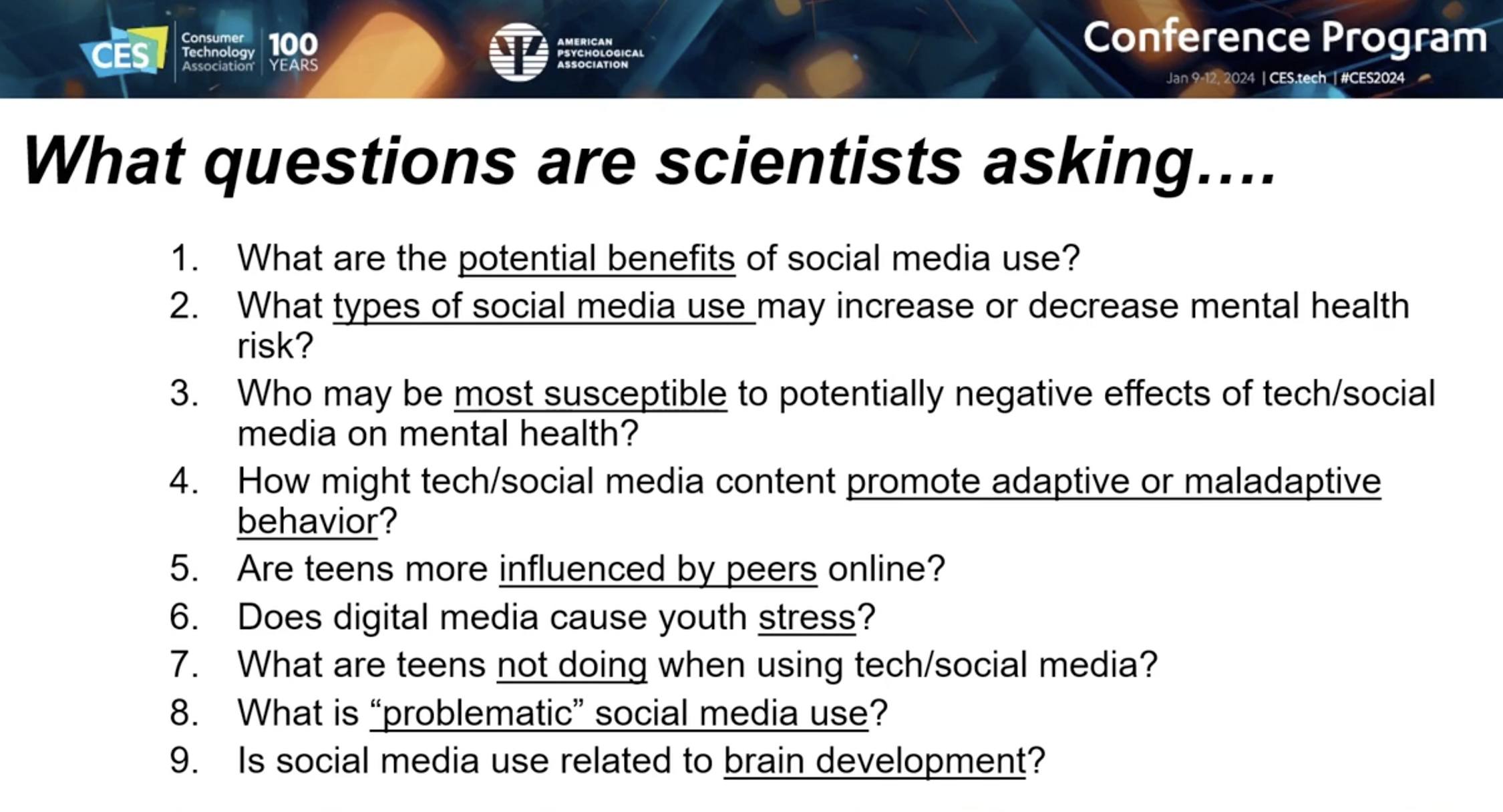
Graphic: Mitch Prinstein, APA

The APA created a summary of this information in the APA Health Advisory on Social Media and Use in Adolescence: https://www.apa.org/topics/social-media-internet/health-advisory-adolescent-social-media-use

Graphic: Mitch Prinstein, APA

Overall, when we talk about social media, there are 3 separate aspects.

  1. Content on SM that kids generate, seek out, or things that are presented to them
  2. Specific features of SM, the “like button, the endless scroll, the follower counts — these are things that are new and different and change our social relationships.
  3. The AI piece, which is new and evolving, and we know less about.

Parents wonder how much time their kids should spend on social media. If they’re reading the New York Times and talking with their friends about political issues, maybe 20 hours a day? joked Prinstein.

But if they’re on SM and being directed to content on how to cut themselves and how to keep it from their parents, less than a minute would be too much.

We have to think about ways of building competencies that could help their development.

You can google APA Health Advisory on Social Media and get our entire document so parents, teachers and other can see what science is saying. (again: https://www.apa.org/topics/social-media-internet/health-advisory-adolescent-social-media-use)

10 Recommendations for Parents, Platforms and Policymakers

  1. Build and encourage use of functions that promote socialization
  2. Tailor platform design, functionality, and permissions to developmental capabilities
  3. Monitor use for early adolescents
  4. Remove content and mininimize exposure to content that promotes illegal or psychologicall maladaptive behavior
  5. Remove content and minimize exposure to content that promotes prejudice, hate or cyberbullying
  6. Routinely screen for signs of problematic use
  7. Limit use that interferes with sleep and physical activity
  8. Limit use that encourages social comparison
  9. Precede use with training teens in social media literacy
  10. Provide resources for continued research on the positive and negative effects of social media on development.

(Excerpted from the graphic below.)

Graphic: Mitch Prinstein, APA

Our recommendations are reflective of a scientific perspective, on how social media can be used to foster healthy and adaptive social milestones, but we need parents to be monitoring social media use. Not looking over their shoulders, but to talk with their kids about what they’re experiencing on social media.

We’re asking tech companies to really think about the adolescent brain and its unique vulnerabilities and capabilities, and to think about making the experiences of an 8 year old on social media different from the experience of an 80 year old on social media. We’re looking at different ways to screen for problematic use, we’re calling for a take down discriminatory and harmful content  — content that encourages maladaptive or psychiatrically disordered behavior.

In particular we’re interested in fostering a conversation around social media literacy. We don’t just give kids the keys to a car and wish them luck as they head down the driveway. We make sure they know how to operate a car in a way that would be safe for themselves and others. With social media, there are no tests to demonstrate that they have the competency to understand fake profiles, mis- and disinformation, how to combat cyber-hate and how to engage in adaptive ways of solving interpersonal conflict. This is based on psychological science. Psychologists have developed interventions to teach kids these skills effectively, so we have those tools. It’s time to bring them to scale. 
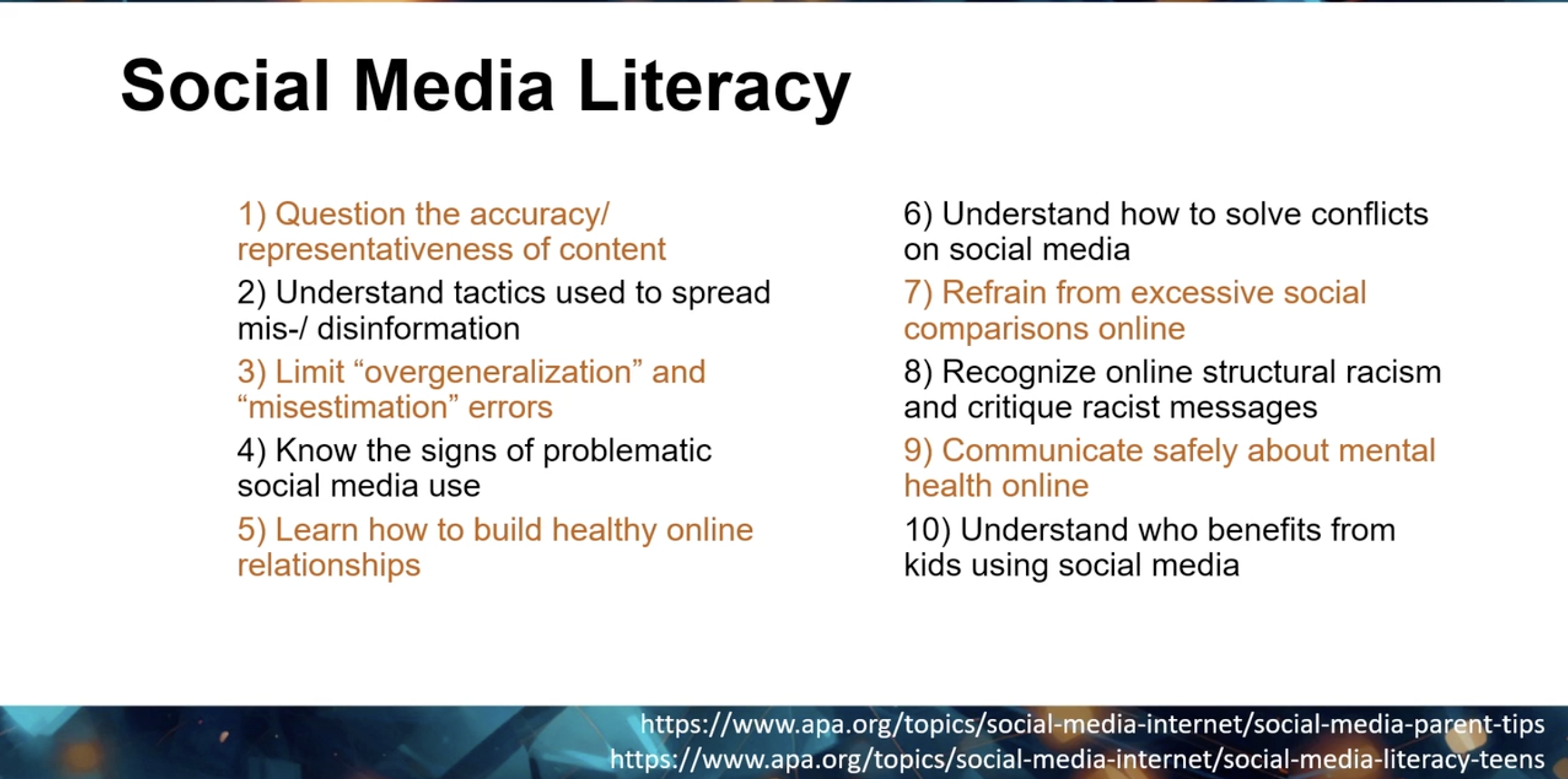
https://www.apa.org/topics/social-media-internet/social-media-parent-tips

https://www.apa.org/topics/social-media-internet/social-media-literacy-teens

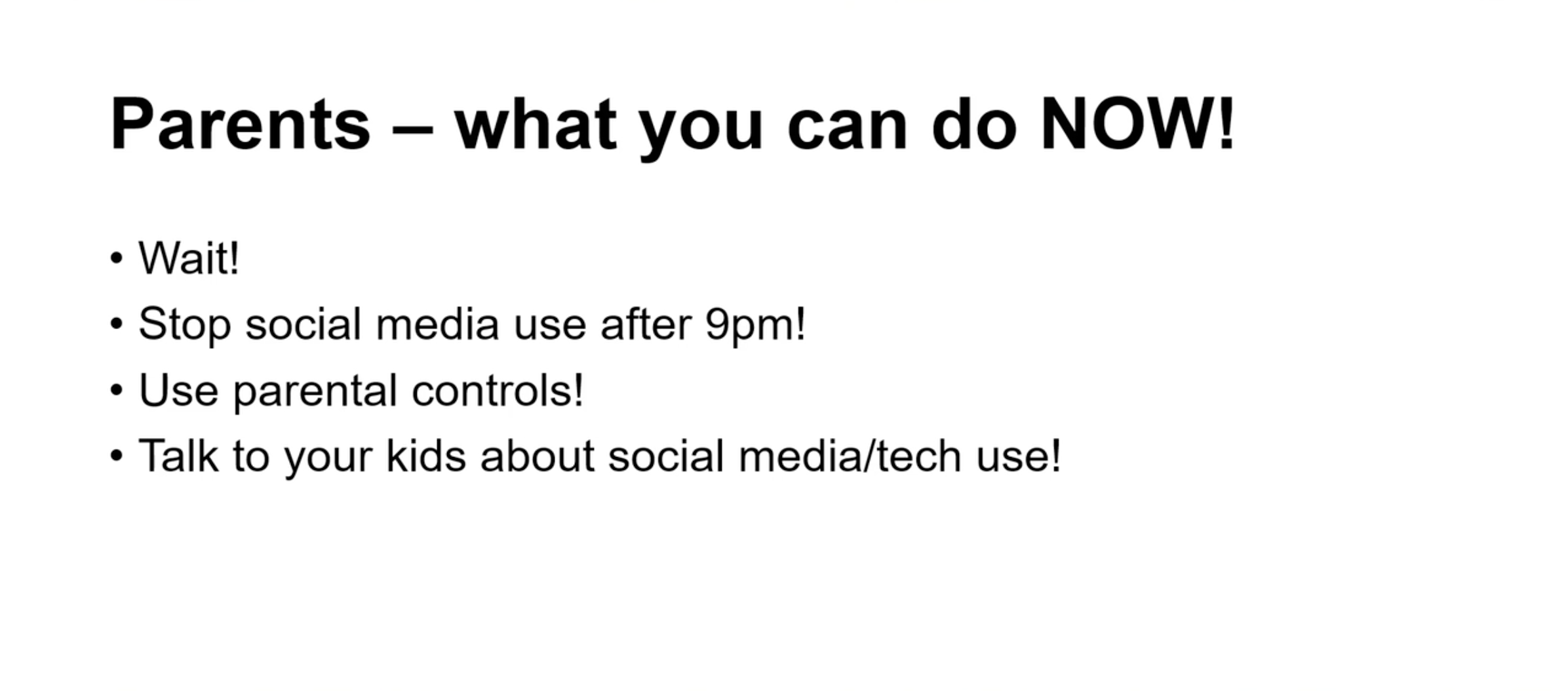
Parents can do so much in this space. There is no psychological science that shows kids are harmed by NOT being on social media. We can stop social media use after 9 PM, use parental controls, and build social media competency.
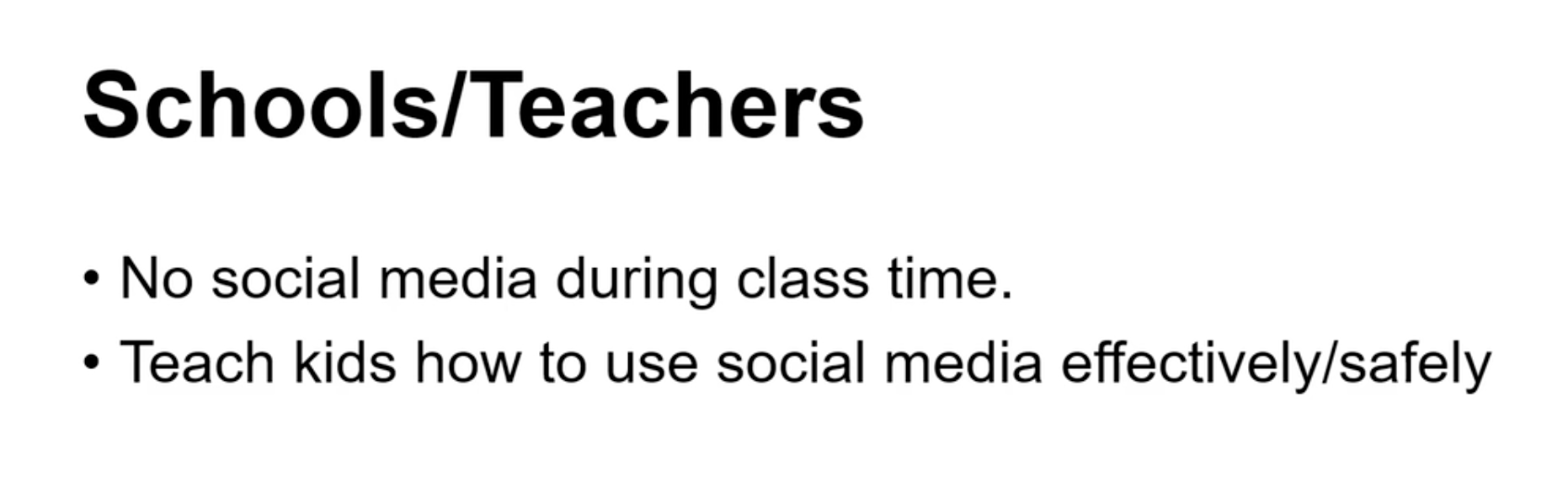
Prinstein suggested that social media should not be allowed during class time, and that schools/teachers should be teaching kids how to use social media safely, and that educators should be teaching kids about the online world. (My note: I’m not an educator, but I have an issue with integrating social media into schools. I see teachers as being burdened with integrating societal changes, which has had a significant impact on their work, and I doubt that educators have the capacity to handle “one more thing.”)
We need to get lawmakers to make sure that kids and their data are protected and we’re not sacrificing their development to help others make a profit.

And we need the tech industry to think of ways that they can put child safety over the model of increased and constant engagement. There are ways this can be accomplished, and that’s what we hope for.


Megan Jones Bell, PsyD, Clinical Director, Consumer and Mental Health, Google

Megan Jones Bell leads consumer and mental health across Google. She shared an overview of how Google approaches the objective of keeping kids and their mental health in the spotlight, highlighting their work on YouTube.

Google is all about creating online experiences that empower kids. Its goal is to provide enriching, safe, and age-appropriate online spaces that respect children’s unique needs while giving families control over technology. Jones Bell said Google builds these experiences with safety in mind from the start, and she shared some recent work done on YouTube, although the efforts extend across Google products.

Jones Bell focused on recent work they’ve done on YouTube. Kids’ mental health, which requires special protection online. They’ve developed 5 Youth Principles that form the core of the work that Google does to create a safer and more enriching environment.
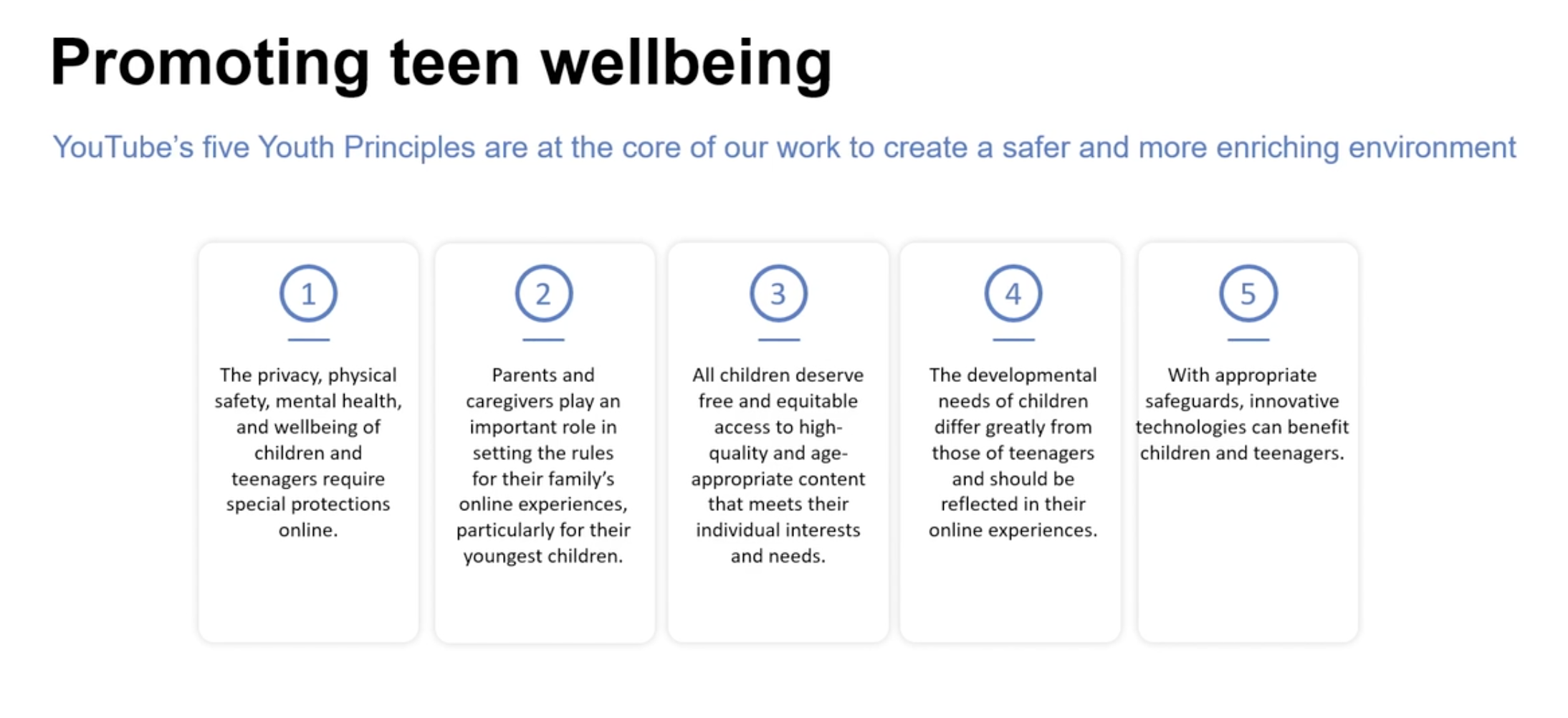
Image: Megan Jones Bell, Google. (Excerpt from graphic, below)

  1. Kids’ mental health requires special protection online
  2. Parents and caregivers should have a say in how technology is used within their families.
  3. Every child deserves access to high-quality, age-appropriate content that suits their interests and needs. 
  4. Developmental needs of children differ from teenagers’, so tech should reflect that. 
  5. With the proper safeguards, kids can benefit from and use innovative technologies. 

Google has already introduced features like “take a break” and bedtime reminders in many Google products, but they’re enhancing them to be more effective by creating moments for pause and reflection. 

Image: Megan Jones Bell, Google

One thing they’re about to roll out is an all-screen takeover (third panel). These will be more disruptive and create more moment to pause which we know is more likely to get someone to disengage.

They’re also changing the way they recommend content by focusing on limiting repeated suggestions of videos that might promote unhealthy social comparisons or social aggression among young viewers. They’ve been eliminated from the “watch next” algorithm on YouTube.
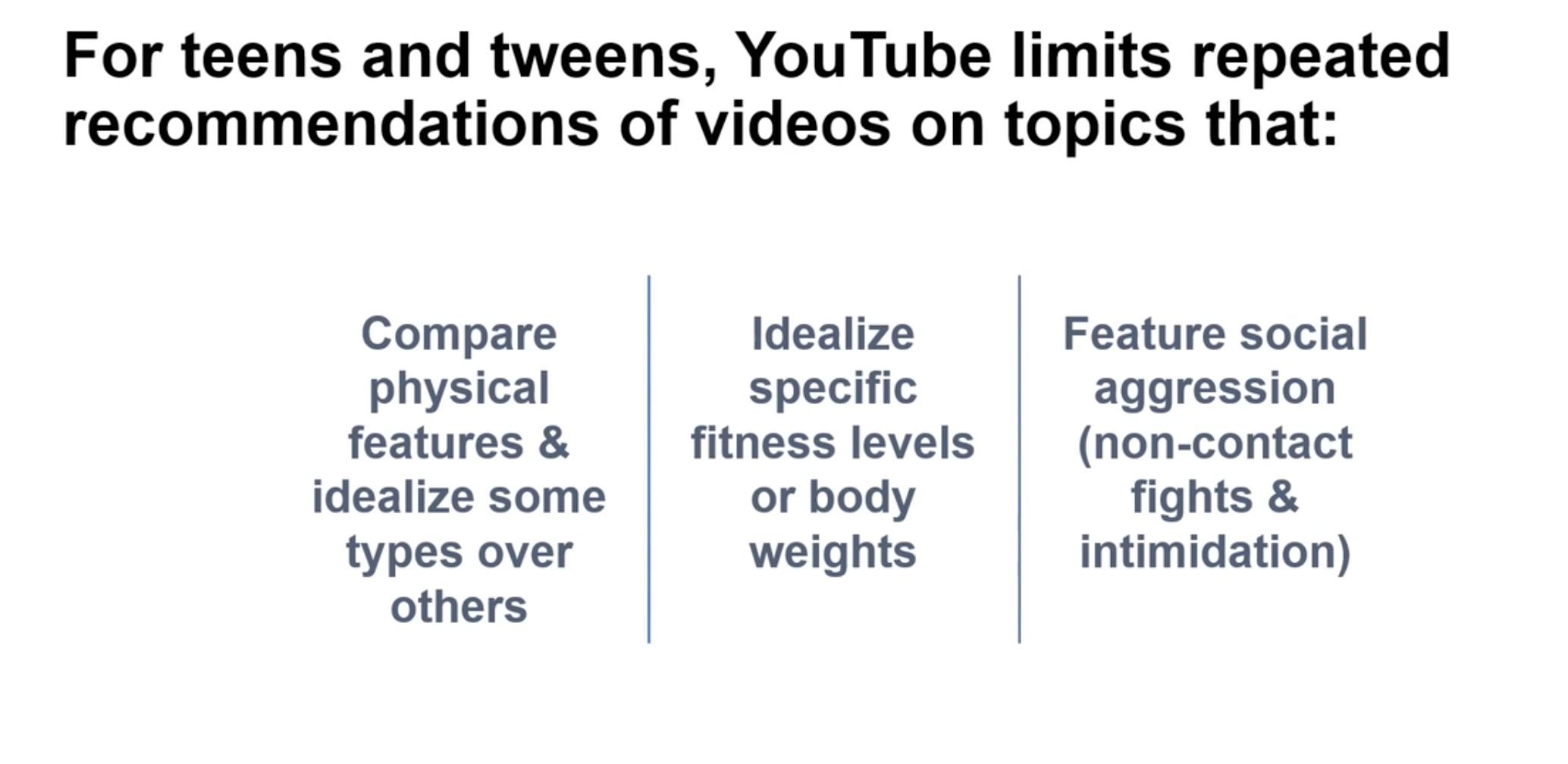
Image: Megan Jones Bell, Google

Google wants to ensure that the content they suggest is safe and positive. To support users during difficult moments, they’ve updated their crisis resource panel to encourage safer searches and offer crisis resources more prominently. (It was a small blue bar in its earlier iteration, but the new “pause” page on the right, is a full-screen takeover.) This way, people are more likely to find help when needed. 

We know from our research that slowing people down in moments of crisis will lead to disengage from problematic search.

Image: Megan Jones Bell, Google

In terms of promoting high-quality health information, they’re working to elevate high-quality mental health content for young teens by collaborating with experts at the National Academy of Medicine and organizations like the World Health Organization. They’ve also partnered with Common Sense Networks to provide training and resources for creators, helping them make responsible and helpful content and promote digital well-being. These are just some steps they’re taking to create a safer and more enriching online environment for kids and teens.

Image: Megan Jones Bell, Google


Ravi Iyer, Managing Director of the USC Marshall School’s Neely Center

Ravi Iyer was present to discuss how we can design social media to have a positive impact on mental health. While social media isn’t solely responsible for mental health issues, there are ways to make it better for those who are affected negatively. Here are two key takeaways:

Platform Accountability: We should hold social media platforms accountable for their design choices, not just the content they host. Creating spaces that discourage harmful activities and incentivize positive ones is essential.

User Experience Surveys: We can use surveys to gauge user experiences and validate whether platforms improve their design. By listening to users’ concerns and feedback, we can ensure that the changes implemented align with their needs.

During his time at Facebook, he realized that existing policies didn’t cover some harmful behaviors, such as fear speech and subtle misinformation. They focused on design changes to address this, like removing engagement incentives that encouraged negative interactions. They also introduced rate and functionality limits to prevent a small group of users from dominating discussions.

These ideas have been compiled into a design code for social media. It acts similarly to building codes. While preventing every bad thing from happening online is impossible, we can hold platforms responsible if their design choices promote harmful behavior. By doing so, we aim to empower users to engage with content that aligns with their aspirations rather than just what grabs their attention.

Says, Iyer, “We’ve started measuring user experiences by asking people about positive and negative encounters on social media platforms. This helps us understand which platforms are improving and where improvements are needed. For instance, LinkedIn stands out for having fewer negative experiences and fostering a more positive environment.”

In the world of AI, we’re also keeping an eye on user experiences to catch potential harms early as AI adoption grows.

In summary, we can create a healthier online environment by holding platforms accountable for their design choices and continually measuring user experiences to ensure progress.


Postscript

CES, one of the largest global tech events in the world, offers thousands of compelling reasons to be make the pilgrimage.

Among the foremost is the chance to be present for groundbreaking product launches. It’s a place where B2B deals and investments are made. It’s a chance to witness the debut of inventions and feel the sensation of the future unfolding before your eyes. You can not only observe but actively interact with innovations. The experience far exceeds articles on the Internet, or mere observation.

We have access to the stories and inspirations behind new technology that exemplify how visionary founders and engineers were driven to bring their dreams to fruition. We can hear from the inventors first-hand and feel the passion fueling their journeys.

In addition to introducing new technology and innovations, CES is a knowledge hub where industry luminaries deliver breaking news at press conferences, and lead thought-provoking panel discussions. These sessions provide an invaluable opportunity to glean insights into the ever-changing landscape of our world. The perspectives are the most up-to-date and feature the best practices across various sectors.

The “Social Media’s Impact on Kids” session featured a stellar panel of speakers. They offered rare glimpses into the behind-the-scenes initiatives driving research and policy, bringing changes to the forefront. It was a journey into understanding the relationship between education, research, and technology, showing how these forces combine to safeguard our children and families.

I did my best to accurately represent the concepts shared by the panel. Any omissions while conveying their thoughts, were unintentional.

In closing, thank you for your interest in this post. CES is the convergence of innovation, knowledge, and potential in technology. It’s a realm where the future is not a distant idea but a tangible reality waiting for us to explore. It was my privilege to take part.


Additional Information:

There are countless resources to support consumers who seek information on social media and its effect on children and adolescents. Here are a a few links to articles related to this post.

Social Media Literacy:

https://www.apa.org/topics/social-media-internet/social-media-parent-tips

https://www.apa.org/topics/social-media-internet/social-media-literacy-teens

Global principles for identifying credible sources of health information on social media:
https://www.who.int/teams/digital-health-and-innovation/digital-channels/global-principles-for-identifying-credible-sources-of-health-information-on-social-media

Health advisory on social media use in adolescence

https://www.apa.org/topics/social-media-internet/health-advisory-adolescent-social-media-use

Neely Center Design Code for Social Media

Neely.USC.edu/Design-Code

Leveraging Google’s Technology to Improve Mental Health
https://researchblog.duke.edu/category/responsible-conduct/

Common Sense – Prepare Your Students for Success in a Connected World

https://www.commonsense.org/education


More about Terri

Her book: Blogging on Instagram
Her store on Alki Beach: Alki Surf Shop
Her business: Terri Nakamura Design+Social
Terri Nakamura on Twitter
Alki Surf Shop on Twitter
The Horsfall House on AirBNB
Terri Nakamura on Linktree

Data Privacy Week – Jan. 22-28, 2023

Data Privacy – Women observe security cameras outside the workplace. Photo by Matthew Henry on Unsplash.

What is Data Privacy Day?

Most of us are familiar with the sinking feeling we experience when we discover that one of our credit cards or online accounts was breached. Personally, in the past, I was more reactive than proactive but changed to now employ 2FA (two-factor authentication). It is an extra step that I find annoying sometimes, but it’s a minor annoyance if it helps protect our data.

Data Privacy Day (known in Europe as Data Protection Day) is an annual international event observed on January 28th. However, its activities often continue for a week or longer. It is depurpose is to raise awareness about the importance of protecting personal information and to encourage individuals and organizations to take action to protect personal information.

Data privacy is important because personal information, such as social security numbers, credit card numbers, and personal contacts, can be used for identity theft, financial fraud, and other malicious activities. Additionally, in today’s digital age, personal information is often collected and shared by companies, governments, and other organizations, which can raise concerns about how this information is used and who has access to it. Observing Data Privacy Day helps raise awareness of these issues and encourages individuals and organizations to take steps to protect personal information.

Preventing Unauthorized Digital Access

Folio Photonics recently showcased its optical storage advancements at CES 2023. Steve Sanatamaria, CEO of Folio Photonics. provided a quote on this very timely and important topic:

“It is no secret that data is at the center of everything you do. Whether you are a business, a nonprofit, an educational institution, a government agency, or the military, it is vital to your everyday operations. It is, therefore, critical that the appropriate person(s) in your organization have access to the data they need anytime, anywhere, and under any conditions. However, it is of equal importance that you keep it from falling into the wrong hands. 

Therefore, when managing current and archival data, a top concern must be data security and durability, not just today but for decades upon decades into the future. The ideal data storage solution must offer encryption and WORM (write-once, read-many) capabilities. It must require little power and minimal climate control. It should be impervious to EMPs, salt water, high temps, and altitudes. And, all archive solutions must have 100+ years of media life and be infinitely backward compatible, while still delivering a competitive TCO. But most importantly, the data storage must have the ability to be air-gapped as this is truly the only way to prevent unauthorized digital access.”

How Can We Get Involved in Data Privacy Week 2023?

Organizations, including the National Cybersecurity Alliance and IAPP (International Association of Privacy Professionals) list activities and events in the coming weeks. Check out the National Cybersecurity Alliance (StaySafeOnline) video below, or visit the IAPP website for more information:

Data Privacy Week, Jan. 2-28, 2023.

Make Data Security and Privacy Safeguards a Habit

There are many reasons why it’s important to be aware and proactive about protecting our privacy and data.

  • Personal information can be used for identity theft, which can cause financial harm and damage to our credit.
  • Companies and organizations may use personal information for targeted advertising, which can be invasive and creepy.
  • Governments may use personal information for surveillance, which can be a violation of civil liberties.
  • Personal information can be hacked or leaked, which can embarrass or damage our reputation.

Protecting our privacy and data is essential because it helps maintain our autonomy and control over our personal information. The more we take measures to secure our data, the greater our sense of well-being.


More about Terri:

Her book: Blogging on Instagram
Her store on Alki Beach: Alki Surf Shop
Her business: Terri Nakamura Design+Social
Terri Nakamura on Twitter
Alki Surf Shop on Twitter
The Horsfall House on AirBNB
More by Terri Nakamura
Terri Nakamura on Linktree

Conversation with Neal Schaffer

Terri Nakamura, Hunter Huntington the Maine Coon, and Neal Schaffer

Exciting things have happened since I published my book, Blogging on Instagram: Engagement Writing on One of the World’s Best Social Media Platforms.

One of the most surprisingly fun experiences has been doing podcast interviews. For those of you who listen to podcasts, you might not be aware of what goes into making them happen.

Each host has his/her own protocol for preparing for a podcast episode. Many conduct pre-production “meetings,” to prepare the guest. The pre-conversation could touch on sequence, types of questions and other things to expect. I’ve found it helps me be relaxed going into an interview because I understand what is going to happen.

Others hosts do zero prep and let the podcast interview become a spontaneous conversation. This is more like “My Dinner With Andre,” a 1980s movie of a 2-hour dinner conversation. They’re often entertaining but this format can leave a guest with a feeling of uncertainty.

There are also pointers for a guest. I found some terrific suggestions from Billy Samoa, CEO and co-founder of Podify, and shared them in an Instagram blogpost.

I recently listened to Celeste Headlee, an award-winning journalist, professional speaker, 20-year veteran of NPR, talk with Jaime Jay about what goes into making a great interview happen. She offered some great advice the best podcasters have employed in preparing me to be a guest on their shows.

It was exciting to finally meet Neal Schaffer at a pre-production meeting. He described our interview “as if we we ran into each other at a conference, and had a conversation where people overheard us like a fly on the wall.” So the interview was a conversation, but Neal also prepared by doing research. The result revealed unexpected information in a fun and interesting way.

Please give a listen to Episode 29 of Neal Schaffer’s “Your Digital Marketing Podcast.

Thanks for listening!

#CES2022 – Virtually Amazing

#CES2022 VIRTUAL EXPERIENCE

The in-person attendance at this year’s Consumer Electronics Show was about 40,000 people – a fraction of the crowd of 175,000 in 2019. But there were dazzling products and experiences offered and attendees were able to gain easier access to exhibitors.

I would have attended as a social media influencer under the umbrella of media, so I have access to media assets to share.

“B-Roll,” in movie and video parlance, is the secondary footage that is shot to add depth, context and interest to primary (A-Roll) video. I reviewed the B-Roll this year and found some really cool things. For example, in the following segment, at about 2 minutes, you can see the BMW model that changes colors:

This time lapse includes views of Las Vegas, the convention center including the new West Hall (at about 1 minute).

THE ONLINE EXPERIENCE

The online experience was a huge improvement over #CES2021. With a completely redesigned interface, it was better organized and offered more features. With 4 channels of live content, there were some interesting topics, panels and panelists. I tried to catch a few each day, but wasn’t always able to make it. The beauty of that is, all of the content is recorded and available to view.

At about 1:10 you can see a panel discussion, on this Jan. 6 segment recording of the showroom floor, but there are lots cool things going on.

CES took extraordinary measures to ensure the health and safety of employees, visitors and exhibitors. It was requested that each person in attendance took a quick covid test before being admitted and covid tests were supplied to each person. Of course, proof of vaccination was required.

The finale of the show was the Indy Autonomous Challenge that took place this afternoon. Forty-one universities signed up to complete in this autonomous challenge beginning in February of 2020. Nine universities were left and joined countries around the world to form eight teams at CES 2022. Congratulations to team PoliMOVE UniversityofAlabama, the winners of the IndyAutonomousChallenge at CES2022 at 150 MPH!

Episode 51: Terri Nakamura – Harnessing the Power of Social Media

Thoughtrow Podcast | Hosts: Rod & Inci Jones | 12/2/21

Click image to listen

SHOW NOTES – Thoughtrow Podcast

Episode 51: Terri Nakamura – Harnessing the Power of Social Media

In this episode, show co-hosts Rod & Inci Jones share their quote of the day and motivational thought, and then discuss the pros & cons of social media and how its impacted their social media presence.

After Rod & Inci’s brief discussion, they introduce Terri Nakamura, who is a Social Media Consultant, Designer, Writer, and Author of “Blogging on Instagram: Engagement Writing on One of the World’s Best Social Media Platforms”.

Their guest Terri Nakamura discusses with them the power of blogging on Instagram and its benefits. Teri shares her tips on how to be more effective in building your brand and notoriety on social media.

She gives the number one takeaway from the interview today, and what would benefit people most when it comes to building their social media presence.

Paperback and eBook available on Amazon

On Barnes and Noble:

https://www.barnesandnoble.com/w/blogging-on-instagram-terri-nakamura/1140055219?ean=9781637304471

On the shelves at Elliott Bay Book Company, Seattle

https://www.elliottbaybook.com/book/9781637304471

Tech Gifts for the Holidays

Two weeks ago, I was invited to join an exclusive gathering of technology aficionados sponsored by the Consumer Technology Association and Techlicious. It was a great opportunity to see and experience new tech gadgets and to get some terrific ideas for the holidays.

One of the features I love about this road show is seeing current trends as well as revisit trends from yesteryear.

Remember 1999?

Going back to 1999, the year before the famous Y2K? Can you believe that was TWENTY years ago? Back then the most popular items included:
1. Color TV – 27” or greater
2. VCR
3. Color TV- less than 27”
4. DVD player
5. Digital camera

A look back at popular tech in 1999

Consumer Technology Association research from 2009

Top choices were laptops, MP3, Flat panel TV, Video game system and Digital camera

Ten Years Later— 2009 Top Trends:

1. Notebook or laptop PC
2. MP3 player
3. Flat panel TV
4. Video game system
5. Digital camera

So in 1999 and 2009, digital cameras made it onto the list, but now, everyone’s phones have such fantastic cameras, sadly for casual camera manufacturers, I’m sure they’ve taken a big hit. In 2019, we see some similar things like TVs and laptops but I think this is the first time wearables made it on to the list.

The Present — Top Trends for 2019:

1. Laptops
2. Smartphones
3. TVs
4. Tablets
5. Wearables

Top Tech for 2019

CTA research revealed the most wanted tech this holiday season to include Laptops, Smartphones, TVs, Tablets and Wearable tech

Another really cool trend in 2019 is giving the gift of content! In fact, 71 percent of those surveyed plan to purchase a content-related gifts like streaming or download entertainment services such as Netflix or Disney+.

So, there are the typical “big-ticket items” on a lot of people’s wish lists, but what are consumers really going to purchase? The Top Tech Gifts people actually intend to buy are relatively more affordable.

Top Tech Gifts for 2019:

• Headphones/earbuds
• Mobile case devices
• Portable battery chargers
• Video game discs
• Portable wireless speakers

What people plan to buy this holiday season

Headphones, Mobile cases devices, Portable battery chargers, Video game discs and Portable wireless speakers

From my own point of view, and writing as a full-time college student, I’m on a budget, so it was great to see gift ideas presented by Mophie, Jabra, Amazon, Fitbit and 1More (and I don’t mean “one more!”) that were affordable, attractive and super useful.

True Wireless Bluetooth

Apple earbuds don’t fit snugly in my ears, and other wrap around options have been uncomfortable, so I enjoyed trying out the Jabra Elite 65t Bluetooth wireless headset.

The Jabra Elite 65t True Wireless Headset

Comfortable and beautifully designed in Copenhagen, Jabra offers great sound quality and noise suppression

The Jabras turned out to be surprisingly comfortable and fit snugly. The sound quality is excellent both from the standpoint of hearing and being heard. I don’t like the idea of having both ears being blocked from hearing ambient sounds and have mostly used single-ear headsets, but it’s not a problem with the Elite 65t. There are also settings to allow you to hear more external sounds, and also you can use just the right earbud, leaving your left ear open to all sound.

They normally sell for $170, but I noticed on the website they’re $110, which is a great deal. The industrial design is handsome, (they’re designed and engineered in Copenhagen) and it comes with a case which is used to store and charge your earbuds.

Amazon Fire HD and Amazon Fire - kids editions

Amazon Fire tablets for kids – Almost indestructible and peace of mind for parents with great parental controls

For the past year or so I’ve been using the Sennheiser Presence bluetooth headset, which also has great sound quality and noise suppression. Its list price is $180. The design is old school, and the ear hook is uncomfortable. Actually, uncomfortable is an understatement!

Tablets for Kids

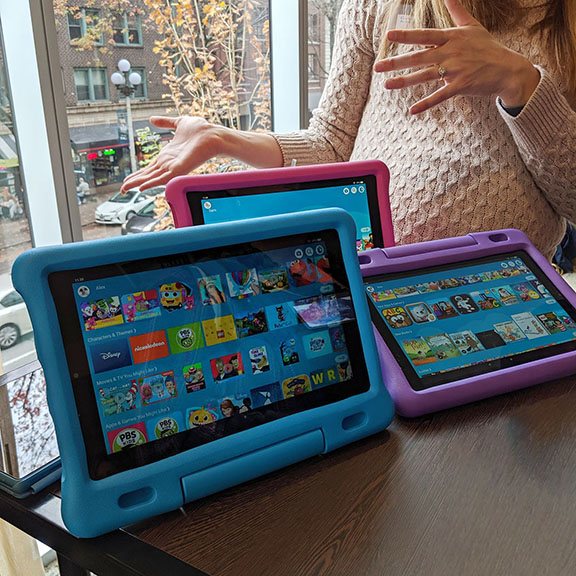
I thought the indestructible Amazon Fire tablets for kids were pretty cool. They give parents control over what their kids are reading, seeing, doing and when. The smaller 7” tablets were around $60 and the larger HD tablet (with more memory) is around $90. A tablet for under $100 seemed great!

Mophie Power stations

Great variety of Mophie power stations and power banks for every need.

Battery Backup Power

There were so many great choices from Mophie and this picture doesn’t do justice to some of the fancier versions, but most range from $30 to $70 with a few more expensive options for powering laptops, tablets and Fast-charge portable hubs with Qi-enabled wireless charging.

________________________________________

What are your thoughts about giving technology for the holidays? Yay or Nay?

Do you live in the U.S.? If so, please leave a comment and you’ll have a chance to win a Mophie Power station!

_______________________________________________

Thanks to Techlicious and CTA for this fun event and for the gift bag of goodies, a great lunch and valet parking. My assessments of the products mentioned in this post are my own and don’t represent the manufacturers, CTA or Techlicious.

More about Terri:

Her store on Alki Beach: Alki Surf Shop
Terri Nakamura Design
Terri Nakamura on Twitter
Alki Surf Shop on Twitter
The Horsfall House on AirBNB
More by Terri Nakamura

Instagram Then and Now

A Brief History

I’ve been using Instagram since April of 2011 when the site was about 6 months old. It seemed like a creative challenge and I didn’t know if I was up to the task. Back then I was most likely shooting photos with an iPhone 4 or 4s (can’t remember which) capturing images at less than 400 pixels per inch. By comparison, the Pixel 2 and Pixel 2 XL I now use are capturing 12.3 megapixel images—so massively greater image clarity is possible.

Looking back at my early photos, they look kind of awful. Despite some images with halfway decent composition, the clarity is “not good.”  Below is a sample, and you can follow the link to blog post with more examples and “tips.”

6013 - 6028 (c) 2013 terrinakamura.png

Minimal Activity = Stagnant Follower Count

I’m not good at “gaming” followers, and unlike many of the huge accounts out there, I have never bought any. So while I was doing “okay,” my account was never great. Then it got worse. In 2016 I accepted a full-time job. It was demanding and negatively impacted my ability to create and engage on most of my social channels, including Instagram. I was basically on “maintenance mode.” I tried to post an image most days, but weeks or months would go by, and I would “like” a bunch of photos, but I wouldn’t exchange comments with anyone! Needless to say, my account stagnated, I lost followers, and I’d be lucky to get 30 or 50 “likes on an image. I was stuck at about 2800 followers and nothing I did seemed to make a difference.

Some of you who know me pretty well are aware I left my job about a month and a half ago. The reason is long and boring, but suffice it to say I’m on the road to recovery and feeling better each day, and one thing that has been soul replenishing is reconnecting with people on social media. Engagement has been essential. I’m now up to about 4100 followers and have made lots of fabulous connections with fun and interesting new people.

Ramping Up

Assessing my Instagram situation, I realized there are now a lot of great photographers  there, some of whom have massive audiences, and I seriously needed to up my game. The first order of business was to be more thoughtful about what I was shooting; then looking at how I was prepping the work, and how I framed the image’s narrative. I’ve been a brand partner of Verizon for about 5 years and I wanted to do a better job representing their products and service, so it meant changing up the way I had been doing things. Instead of “maintenance mode,” it was more like, “Banzai!”

Before and After

I’m going to share a series of “before and after” photos, so you can see what a difference it makes to properly prepare your images. This means cropping, sharpening, adjusting contrast, boosting the color saturation, and applying filters.

Here goes:

Maker:0x4c,Date:2017-11-19,Ver:4,Lens:Kan03,Act:Lar01,E-Y

Kind of a “blah” shot of Alki Beach, right?

After being cropped, adjusted and filtered, it looks so much more interesting, AND detail in the bird that I didn’t even know was there, shows up.

©Terri-Nakamura_Alki-Beach-IG-20180627_232201_127

One thing I’d like to say about Instagram — there is no shortage of brainy people there. Seems that each time I post something and don’t know what it is, a number of viewers will chime in and school me! An example is this shot below. I didn’t know what the flower was, and boy, did I get some great feedback!

Maker:0x4c,Date:2017-11-19,Ver:4,Lens:Kan03,Act:Lar01,E-Y

The bee isn’t very apparent. Maybe because there are many distracting things in the shot, plus the color is subdued.

©Terri-Nakamura_Allium-bee-IG-20180721_205509_931

That’s better! And as Verizon says, “Better Matters!” And for the record, the flower is an Allium.

Reg Saddle @zaibatsu and I frequently discuss things like what the algorithms are rewarding or penalizing, and how it affects what we do. One of the things we go back to is what our audiences want. Think about what you post and which things get the most traction.

Here’s something “off the beaten path” for my feed — a glassblower in the Glassy Baby hot shop, not far from where I live. One of the most necessary steps was to crop this photo. You’ll see what I mean.

Maker:0x4c,Date:2017-11-19,Ver:4,Lens:Kan03,Act:Lar01,E-Y

Interesting but a lot going on, right? Below: where the action is.

©Terri-Nakamura_GlassyBaby-IG-20180723_215223_959

Maker:0x4c,Date:2017-11-19,Ver:4,Lens:Kan03,Act:Lar01,E-Y

My “boyfriend,” Hunter. Dark. But cropped and adjusted:

©Terri-Nakamura_Hunter-IG-20180728_221254_803

I don’t know about you, but our cats are shedding like crazy!

Maker:0x4c,Date:2017-11-19,Ver:4,Lens:Kan03,Act:Lar01,E-Y

So my brother-in-law is the head of the California Leafy Greens Board. His wife (is she my sister-in-law?) said this is NOT a thistle. But man. I’ve never seen an artichoke this tall. The main thing is, too much is going on and did you see the bee? Take a look:

©Terri-Nakamura_Thistle-bee-IG-20180727_223213_153

I almost hate to show you this one. Check out this tree photo, taken on a dreary Seattle day in late spring. I have a thing about shooting UP a tree. This is a classic case.
©Terri-Nakamura_Tree-20180417_190945.jpg

I didn’t like the way the trunk was drawing the eye away in the bottom right corner. Cropping was calling. But how about those colors? Drab!

©Terri-Nakamura_Tree-IG-20180714_234817_201

Through the miracle of filters, the tree came to life!

Maker:0x4c,Date:2017-11-19,Ver:4,Lens:Kan03,Act:Lar01,E-Y

So this is a weird one. I noticed this magnolia blossom was so heavy, the bough brought the blossom to my eye level. When I peered inside, I was like, “WHAT?!?” Very cool, but I knew there was potential in making this better. As shown below, I cleaned up the shot, and there is now more detail and clarity.

©Terri-Nakamura_Magnolia-bees-IG-20180731_223407_789

Yes, folks. The bees were having a cabana party! Interestingly the following day, ZIP.

Maker:0x4c,Date:2017-11-19,Ver:4,Lens:Kan03,Act:Lar01,E-Y

This shot is just plain beautiful any way you look at it. But even something this perfect can look better through cropping and a number of adjustments.

©Terri-Nakamura_Wild-roses-IG-20180713_221643_086

Things to Try

So, you can see that even a somewhat hopeless-looking photo has potential. It’s about post-production. Some things to think about:

  • Composition
  • Cropping
  • Color Adjustment (including saturation)
  • Ambience
  • Sharpening
  • Clean up
  • Filters

I’ve witnessed incredible transformations of the images posted by beginners who then found their mojo. Their photos went from “not good” to amazing!

If you’re on Instagram and follow me, simply post a comment on one of my images to let me know that you’re following, I’ll reciprocate! Here’s a link to my feed: https://www.instagram.com/terrinakamura/

If you’re NOT on Instagram, what are you waiting for? 🙂

If you have any questions or comments, I would love to hear from you. Just let me know!

More about Terri:

Her store on Alki Beach: Alki Surf Shop
Terri Nakamura Design
Terri Nakamura on Twitter
Alki Surf Shop on Twitter
The Horsfall House on AirBNB
More by Terri Nakamura

Alki Surf Shop Turns 4!

Alki Beach-June 2015-© Terri Nakamura (2).jpg

Next month will mark the four-year anniversary of a small journey my husband, David Horsfall, and I started in 2014. Alki Surf Shop began as an online store that became a brick and mortar reality once we were able to locate retail space on Alki (pronounced ALK-eye) Beach. Retail spaces are rare, and it was through a chance conversation that we learned of an imminent storefront space opening up. Tucked around the corner from Homefront, the most popular ice cream store on the beach, it’s not the easiest place to find, but people find us, and somehow we’ve become a destination of sorts. We’ve cultivated a loyal base of customers—many of whom have become our friends. Our fans and supporters want us to succeed, and they bring in friends and family whenever they have visitors, from everywhere.

It’s been an amazing learning experience, and I can say with certainty we are doing most everything more intelligently than when we started (there is always room for improvement, though). Along the way we have met thousands of people from all around the world and have 4 volumes of guest books to prove it. Packed on every page are drawings, messages of goodwill, and touching expressions of friendship spanning every continent and country, often written in the language of the visitor.

In the store’s nascency, I brought in a Nokia* tablet to use, but eventually we needed full-powered computer and replaced the tablet with a 21’ iMac. Our music continues to be piped out onto the sidewalk with a UE Boom* that it has been in use nearly every day for the past 3 and a half years and is still going strong! We have a WeMo* camera for security, and our Verizon service has even rescued us when our credit card terminal service was down by enabling us to use Square to process transactions. This is all to say, for a very low tech-looking, laid-back beach store, we depend on technology to keep the wheels turning each day.

It’s gratifying that beside that fact that we offer a valuable service, our business provides so much joy to our visitors. Most people enjoy the friendly vibe where we take time to learn where people are from and what brings them to Alki. Each day we have customers hug us as they’re leaving. How many businesses can say that? And many exchange a conspiratorial wink with us when they introduce new people to our store. They whisper, “Are you going to do the ‘horn,’” which is actually the blowing of a conch shell and shouting of “mahalo” as customers depart.

Seafair Pirates © 2015 Terri Nakamura.jpg

We’re in the midst of our busy summer season and look forward to some fun upcoming 2018 events:

Beside the special events above, on an everyday basis there are things happening — Saturday salsa dancing, volleyball tournaments, beach parties at the fire pits, paddle boarding, bicycle rentals, and happy people everywhere.

Looking out at the view from our store and seeing the Olympic mountains and Puget Sound, we are reminded that life is better on a beach.


We’re grateful to our real-life and social media friends from Twitter and IG who have visited Alki Surf Shop. If you’ve visited the store please let me know so I can add your moniker here!

@queenhorsfall @jackandpele @muz4now @lorimcneeartist @jenniferannegood @nixkuroi @felicelam @blueweed_songs @becauseuarehere @savvyangie @kurt.nac @Joe996s @sheelala @lemness @wasian206 @dougplummer @michipeterson @lindacriddle @kennapete @lindafreeman_ @jshuey @thidekow @ryankanemagic @vickiehorsfall @freshprinceofmi @crimsonlotustea @x2tap @jrome2032 @hollymariephotos @slydehandboards @feliciakayne @artistpoint @mikedadams206 @horsfallscott @georgesta3000 @PutBarber @lupdesign @lindabrill


More about Terri:

Visit her store Alki Surf Shop
Terri Nakamura Design
Terri Nakamura on Twitter
Alki Surf Shop on Twitter
The Horsfall House on AirBNB
More by Terri Nakamura

*Verizon generously provided us with technology used at our store.


Holiday Gifts for the Techie in Your Life

The past few weeks have afforded me opportunities to connect with friends, old and new, in real life. For a social media aficionado, there’s something special about getting to meet the people behind the half-inch avatars we encounter on Twitter.

It was great to see Suzanne Kantra @Techlicious, Megan Wristen @MeaganWristen, Josh Kirschner @joshkirschner, Terumi Johnson @helloterumi and see other familiar faces at the CTA Seattle Technology Event produced by the team at Techlicious.

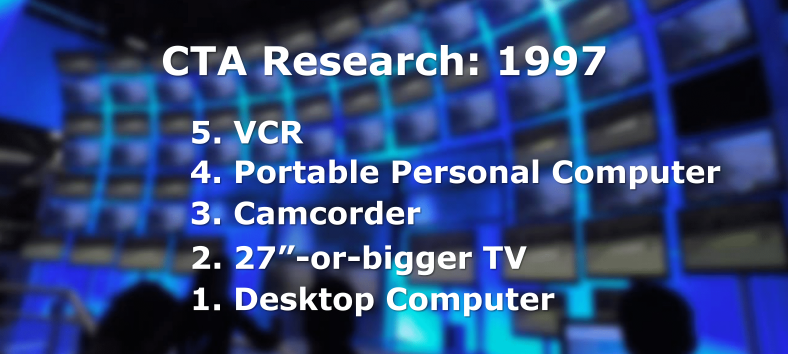
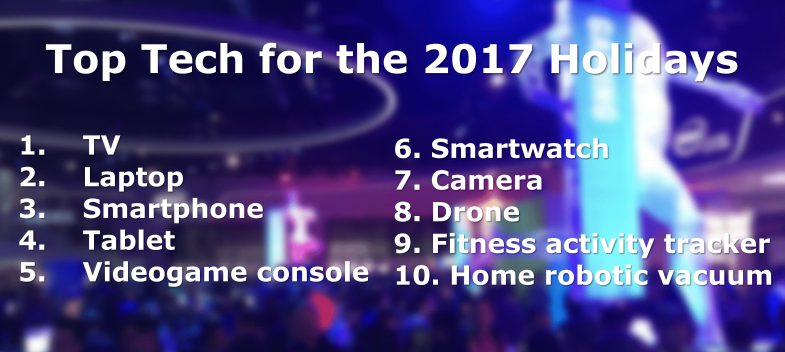
But what was even more cool was to get a hands-on opportunity to check out some of the most popular tech gift ideas for the coming holidays. It was fun to take a retrospective look at what was popular in 1997 and 2017…like, “VCR*?” Remember them?

CTA RESEARCH 1997CTA RESEARCH 2007

It made me wonder how the 2017 top of the list will look in 2027?

CTA TOP TECH 2017

Personally, I enjoyed using the TREKZ Titanium Bone Conduction Headphones. The name sounds weird, but they work great! The product design is unusual, but the proof was in using them. The sound quality is rich, and because they sit outside my ears, which again sounds odd, they allow me to be aware of what’s going on around me. They were originally developed as a sports headphone, and would be a terrific gift to use while running or working out.

Another cool and affordable item was the iHome | Control wifi-outdoor smart plug, which works with Apple HomeKit, Amazon’s Alexa and Google Assistant. I don’t have my lights up yet, but it will be great to be able to control them remotely, and after the holidays, other appliances using my iPhone. “Hey Siri? Turn on the lights!”

There was a great variety of products on display. I took some photos of a few of them and loved learning about them.

Top, left to right: Ecouvacs DEEBOT 995 (it vacuums and mops your floors) ,a fun fashion Fitbit bracelet and Fitbit Ionic health trackers, Middle, left to right:  Lily Next-Gen Pro (drone), Play Impossible game ball, that takes digital action indoors and out, Samsung Gear VR powered by Oculus, Bottom, left to right: another shot of the VR headset, Amazon Echo Plus hand free smart hub, and the Lenovo Tab 4 10 (tablet for the family),

With so many amazing products out there, I’m trying to decide what I’m going to buy for Christmas this year!

Good luck with your holiday shopping!

If you’re interested in any of the products here, just click the link to find out more, or contact Danielle Cassagnol, CTA: DCassagnol@cta.tech (email) @ConsumerTechnologyAssociation (Twitter).


*VCR = Video cassette recorder

More about Terri:

Visit her store Alki Surf Shop
Terri Nakamura Design
Terri Nakamura on Twitter
Alki Surf Shop on Twitter
The Horsfall House on AirBNB
More by Terri Nakamura

Holiday Madness to Gladness

christmas-decorations

What would you say to making holiday gift exchanges a pain free, sure thing ?

Every year our family members shop brick and mortar stores, and scour the Internet to find gifts for each other. We often email wish lists with ideas, and to make it mistake-proof, sometimes there are even links going to the exact item! (I’ve been guilty of this.)

Most often, the same list goes to everyone in the family, so if we don’t check with each other, it’s not unusual for two people to buy the same gift for someone. Duplicates have been re-gifted, returned or traded, but inevitably, everyone smiles and says thanks!

There is at least one person who doesn’t believe in gift lists and buys whatever feels right, regardless of whether someone wants it or not. And at least there’s no chance of duplicates!

For a couple of years I’ve been wanting to try an experiment during the holidays. It’s really a pretty flexible, and potentially stress-free strategy.

I have the best family. Six months ago I asked them to try an experiment for our holiday gift exchange, and this is the year everyone is on board!

The experiment  🙂

Instead of sending out lists of things we want, each person is simply in charge of buying their own presents this year. Each present we buy ourselves will be designated as a gift from another family member. Family members will have no idea what they are “giving.”

lg-k8-v-pdp-d-key-feature-5

For example, I could buy myself a new LG K8V smart phone and wrap it up as a gift from my husband, David. He knows I love technology and gadgets, but he is a self-avowed neo-Luddite and wouldn’t know which features matter to me or what phone I’d want. But if I know I want an LG K8V and I buy it, when I open my gift from David, he will be surprised, and I end up with a perfect present!

For David, it might be a load of lumber to build a new basement stairway at our vacation home. I don’t know a thing about treads and risers, but HE does!

Do you see how this can work?

In all cases, there will still be an element of surprise because no one knows what they are giving to the other recipients. It might even provide insight into the things some of us really like. AND, all clothing will fit; there will be no unwanted duplicates, and whatever a person’s budget is, it will work! Furthermore, we end up buying the same number of presents as usual…or maybe even fewer.

My brother, a retired Sr. Technical Fellow for Boeing, asked, “Can we buy one gift and make it from everyone?”

AND OF COURSE, THAT WORKS!

If you’ve been wanting a big-screen television, or a computer, you can buy it and make it a gift from the whole family. One-stop shopping and you get something you really want and need.

Or maybe you are tired of getting “stuff” and are trying to purge things instead of acquire more possessions? You can buy a bottle of your favorite nail polish, a pound of your favorite coffee, or a new supply of socks or underwear. You get the idea — maybe kind of unglamorous stuff, but things you really want, need and will happily use.

If the thing you love about gift exchanges is the look of surprise on someone’s face, just remember, it can still happen. It’s just that the look of surprise is on “your” face when you see what you’ve given someone!

So, what do you think? Is this a hair-brained idea or a stroke of brilliance? I’ll report back with the results of our experiment whether it’s a success or a bust!

Meanwhile, U.S. residents who leave a response to this post by December 12, 2016, will be eligible to win a new Verizon Smartphone: the LG K8V— a beautiful Android device with a ton of amazing features, including a large 5” HD display, a hands-free “selfie” feature, an SD-slot and removable battery. And it’s a good traveler since it works in more than 200 countries. I’ve been impressed with LG for its amazing color quality, quick charging and ease of use.terri-nakamura-lg-k8v

The winning comment will be chosen by one of my cats. The selection will be posted here, and you’ll need to check to see if you’ve won. I’ll give the winner 2 days to get in touch with me to provide me with mailing information. If I don’t hear from him/her, I’ll move to the next in line.

Who knows? You could end up with your own Christmas gift, courtesy of Verizon 🙂 


 12/12/16 — THE WINNER OF THE LG K8V can be found here: https://www.youtube.com/watch?v=sqltzLOQsas
Please contact me with your mailing address!