Racing Bigfoot in the Shadow of Mount St. Helens

Joe Galioto

Imagine running a 200+ mile race in four days, over impossible terrain, with only six hours of sleep.

Some of us think our jobs feel like that!

But in fact, this is exactly what Joe Galioto did, along with 58 other athletes who completed the Bigfoot 200, an extreme endurance run that traversed Mount St. Helens in Washington State.

When Susan Galioto inquired about our AirBNB property in Lewis County, Washington, it was a head scratcher. Based in New Jersey, she wanted to reserve the house for nine days, but for about half the time, it would be empty. She then told me the reason: her husband was coming to participate in The Bigfoot 200, and for the duration of the race, he would be on or near Mount St. Helens, one of the most active volcanos in America.

I did some checking and found out some interesting facts about Bigfoot 200:

  • Just under 50,000 feet (15,240 meters) of ascent
  • More than 96,000 feet of elevation change
  • 203.8 miles long, non-stop, point-to-point
  • Start: Mount St. Helens in the Cascade Mountains; Finish: Randle, WA in the Big Bottom Valley.

When asked if there any races as long or difficult as the Bigfoot 200, race director Candice Burt responded, “Yes. There is the Tahoe 200 and Colorado 200, and other difficult races that are even longer or have extreme weather, like snow or heat. [But] it is my opinion that the Bigfoot 200 is the most difficult 200-miler in the United States.”

Prior to a reservation, it’s important to communicate with our AirBNB guests in real life or by phone. It helps us anticipate issues that may arise, but in addition, it’s a chance to get to know interesting people like Joe and Susan whom we’d otherwise never have a chance to meet. As the race time was growing closer, we nailed down the logistics of getting them the keys and directions, and I mentioned that there is no cell phone service beyond the town of Morton except for Verizon. Fortunately, like us, they were Verizon customers.

The Horsfall House is a 100 year-old farmhouse filled with a sweet spirit.

My husband, David Horsfall, and I purchased the property 25 years ago, when we realized our two young sons were growing up in the city, and had no experience playing in the woods, building fires and doing things that we did when we were kids. There are trails running through the 22 acres of forest, and there are meadows surrounding the house, which is just a few minutes from the Gifford Pinchot National Forest. It’s an easy drive to Mount Rainier and Mount St. Helens, and a great place to get acquainted with nature.

A couple of days before the race, Joe flew into Seattle, then drove two hours to Randle to familiarize himself with the area, and to train and explore. He arrived at the property on September 4th and described his first reaction:

When I first drove up the drive and parked by the house and got out of the car, I felt this incredible surge of energy and emotion, I felt like I belonged there.  Not sure if you’ve ever had an experience like this, but it is powerful.  I didn’t even go in, I just walked around the property, the house and to the shed and then finally the front porch where I entered.  It was like I was revisiting a place I had been before and I was just walking around checking to see that everything was the way I remembered.

Before I unpacked the car, I called Sue and asked if there was any way she and the boys could fly out, I knew it was crazy and far-fetched (but hey, running 205 miles in the mountains was somewhat far-fetched too) – I just felt like I was “home” and they should be there. That they would love this house and property as much as I did, and I was only there for five minutes. 

Whenever he is asked how he trains, his typical response is “run lots,” which is funny and obvious, and not far from the truth.

He is a NASM-certified personal trainer, USAC cycling coach, and RRCA running coach, but stresses that regardless of events he enters (and the required training), the needs of his family take priority.

About his preparation, Joe says,

“I make up workouts that don’t require as much time, but attempt to duplicate the same stress my body would be feeling late in a race. Additionally, strength-training, back-to-back training runs and strategic races such as the “Running with the Devil,”  hosted by the NJ Trail Series, which consists of running 1.5 miles up-and-down a ski slope for 12 hours, all play a role, but most important of all is mindset — I’m a firm believer that with the proper training and a positive mindset, you can achieve your goals.”  

Joe reached the “downtown” Randle area early Sunday morning, and as he walked fast towards the White Pass High School finish line, many people driving by slowed down to say “hello” or congratulate him. He saw the race director, Candice Burt, along with members of her team; photographers; runners who finished earlier; friends he’d met only days before — all clapping and cheering. He continued to fast-walk until the final turn. Filled with feelings of pride, euphoria and gratitude, following a grueling four-day challenge, he began to run. Arms pumping, knees high, he sprinted the last 100 meters and crossed the finish line with his hands in the air. There was never a doubt!

Before heading back to New Jersey, Joe had several hours before he needed to get to the airport. So he made a trip to Alki Surf Shop where David and I were working that day.
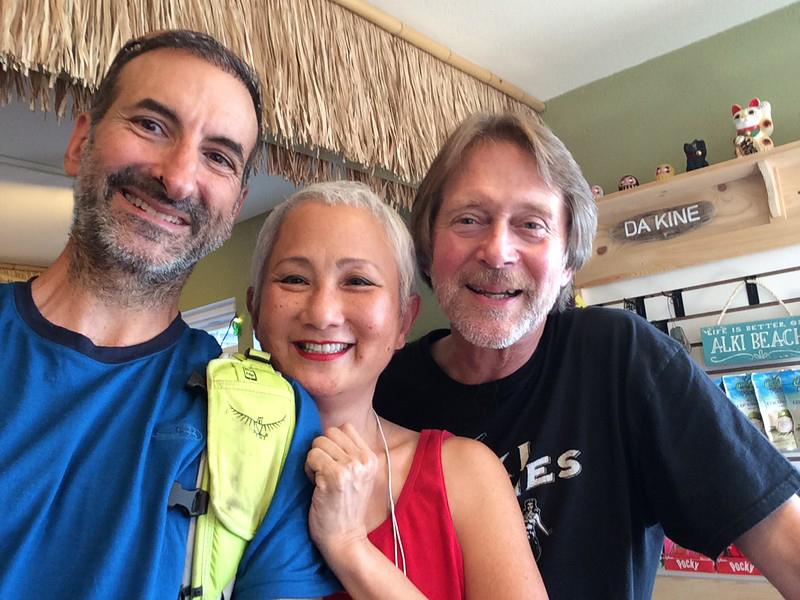
Selfie of Joe, Terri and David at Alki Surf Shop in Seattle, WA

Selfie of Joe, Terri and David at Alki Surf Shop in Seattle, WA

Hearing about Joe’s connection to our home, and the exhaustion, hallucinations, and pushing himself to extreme limits to reach the end, was amazing and awe-inspiring. David and I felt fortunate to meet him, and honored to play a small part in such a remarkable achievement.

The finishers:

http://www.ultralive.net/bigfoot200/webcast.php

Joe’s path:

Joe Galioto Bigfoot 200 map

A Spot satellite tracker enabled family and friends to track Joe’s progress

The course was out of cell phone range, so it was critical to be able to have a way of letting others know his location. Joe wore a Spot satellite tracker, which enabled family and friends to track his progress, and if he had needed it, provide emergency responders a way of finding him.  Each dot in the photo represented his location. If you see it on the web site, you would see tailed information (such as time of day) when mousing over the dots.

Mount St. Helens crater

Joe approached the Johnson Observation area just prior to sunset, and was treated to the beautiful sight of the Mount St. Helens crater, awash in alpenglow.

waterfall2-L_SM

Unexpected beauty along the race path

Along the Lower Falls section of the Lewis River (approximately 110 miles into the race), the view of the waterfalls was just incredible.

lavatrail2-L_SM

Traversing boulders

The first section of the race ended in Blue Lake 12 miles away, but required an awesome traverse of the Mount St. Helens’ blast zone boulder field.

11904685_477195072450384_4688282115499539193_n-L_SM

Fixed ropes to scale a steep wall

Climbing out of the canyon and heading towards Windy Pass (approximately 20 miles into the race), required the use of a fixed rope to scale the very steep incline.

11406717_10206727189195865_7586543149371867028_o-L_SM

And as for Bigfoot? He wasn’t spotted.

Photos and captions by Joe Galioto


Streams of Consciousness

This image was found, unattributed, on an Instagram feed. The original photographer is  Magdalena Wasiczek. http://www.popphoto.com/photos/2013/09/behind-photos-magda-wasiczeks-surreal-floralscapes

This image was found, unattributed, on an Instagram feed. It had 223 likes at the moment I took this screen shot. The original photographer is Magdalena Wasiczek. http://www.popphoto.com/photos/2013/09/behind-photos-magda-wasiczeks-surreal-floralscapes

Or, How Instagram morphed into a Tumblr blog

When I first started using Instagram four years ago, it was a cool photo-sharing site where anyone with an iPhone could apply filters to make an average photo look awesome.

As with most social media channels and applications, people discover inventive uses and loopholes to exploit sites and apps in ways that might not have been originally anticipated.

Such is the case on Instagram.

Instead of viewing original photography, I’m seeing a large volume of plagiarized photos or reposted images designed to increase the popularity (likes) of a given user’s stream. Inspirational quotes, as well as cartoons and memes also take up a lot of space. In my view, non-original photographic content has proliferated like milfoil, much like random sharing on Tumblr.

I wondered if my observations were unique, so as a reality check, I asked several of my favorite friends on Instagram what they thought.

The vast majority of those I asked felt it was wrong to share photos without at least acknowledging the original photographer. People with streams full of this type of content are open plagiarists, and continue the practice because Instagram doesn’t care.

An exception would be feeds that are dedicated to “featuring” a photograph and attributing the user who created that content.  Some of these feeds are well moderated and only share and attribute original content from users who tag their work with the feed’s dedicated tag (granting permission to repost the work).

On the other hand, is there any point in being overly concerned by the sharing of non-image or appropriated content? After all, Instagram as a place for people to share things they feel will be of interest to others, and as long as the content is allowed by Instagram, is it really a problem?

It’s a problem when you have a friend on Twitter and follow their IG feed, only to find things you don’t want to see. As far as I know, there is not a lot of choice except to unfollow.

Currently, there is no way to “mute” users or content you don’t wish to view. So the only thing one can do is to unfollow accounts where the content doesn’t interest you. It can be awkward because some people become upset when they are unfollowed. Some even feel they must unfollow you as “payback.”

To that I say, “Oh, well!”

To my knowledge, searching via hashtag is one way to see a topic, but there isn’t a way to list people whose images you really want to see. If there is an app out there to do that, please tell me!

How do you use Instagram?

Would you like to see a a list feature to help filter what you see?

I’d love to to have you share your thoughts.


The friends who provided information to help me write this post include: Jack Higgins (JackandPele), Reg Saddler (zaibatsu), Cheryl Senter (CherylSenter) and Darren Sproat (DarrenGSproat). My thanks to them for their friendship and support.

Jack Higgins marches to the beat of a different drummer. Former advertising creative director and writer, Jack has found a new way to use Instagram. For a while, I didn’t understand his cryptic images, until I looked at his page and saw the puzzles, solved. They form mosaics! I should note, everything Jack does is thru the thought control of an evil dog named @tipytomita!

Jack Higgins composite

Reg Saddler is an amateur photographer and social media guru, listed on the Forbes list of top people on social media and too many other lists to name. He understands the hows and whys.

Reg Saddler composite

Cheryl Senter is a professional photographer working in New England. I had the pleasure of meeting her here when she visited Seattle two years ago. Her Instagram feed focuses on her amazing dog.

Cheryl Senter composite

Darren Sproat is a Canadian photographer known for his landscapes. He has been featured on the Nokia blog and cultivated a fan base (including me!)—all in awe of his images.

Darren Sproat composite

Thanks to Verizon for the Galaxy Note 4 used for many of the images posted on my own instagram feed: https://instagram.com/terrinakamura/

The Enduring Legacy of The Kingsmen—Part 1

At the time, they didn’t know it would change the music world, and their lives, forever.

Interviewing current and former Kingsmen members Dick Peterson, Steve Peterson and Barry Curtis, as well as Hollywood Walk of Fame DJ, Brien Bierne, wasn’t just fascinating—it was fun. They talked to me about The Kingsmen, “Louie Louie,” and how it all began more than 50 years ago.

Francis Ford Coppola once said art depends on luck and talent. For the legendary Kingsmen, it involved luck and talent, but timing as well. Dick Peterson, one of the band’s early drummers, is quick to admit The Kingsmen’s rocket to fame was the result of the perfect musical storm.

In the early 1960s, rockabilly stars from the 1950s were still churning out hits. But the early 1960s also ushered in new and eclectic sounds ranging from novelty songs to musical styles including folk, doo wop, rhythm and blues, surf and Motown. Of that time, Peterson, “The fan focus was shifting from individuals like Elvis, Fabian and Frankie Avalon to an era of bands.’”

As the musical scene was evolving, former disc jockey Brien Beirne, sees one event as a major catalyst. “In fall of ’63 when The Kingsmen came out with ‘Louie Louie,’ a very interesting thing happened that I think changed everything musically,” he reflects. “It was the death of President John F. Kennedy. Everybody was looking for an escape. It was such a horrific, devastating moment, and I believe it opened the door to lots of new sounds. The Kingsmen were part of the wave that represented escapism for the youth of the day.”

Image

Louie Louie 45 RPM © 2006 Richard Peterson

So, in April 1963, when five young guys in Portland, Oregon, recorded an audition tape to land a gig on a cruise ship, they were unprepared for what was about to come.

The Kingsmen’s version of “Louie Louie” was popular in the Portland area, where it enjoyed cross-pollination by local KISN AM rock DJ, Ken Chase. Chase also financed the $36 needed to produce the demo destined to become the iconic hit single, and hosted The Kingsmen as the house band in his teen nightclub, The Chase. Beirne, who was a teenager in the Portland area at the time, remembers it being such a hot ticket “that it didn’t matter how many pimples you had—if you could get a table for you and your date at The Chase, you were ‘golden’ for the evening.”

The band enjoyed success and played packed houses, but it wasn’t until Boston’s most popular DJ, Arnie Ginsburg, aired the song as “The Worst Record of the Week,” that “Louie Louie” experienced a meteoric surge in popularity. The reason? Unintelligible lyrics had teenagers imagining the words were laced with profanities and descriptions of sexual acts!

They didn’t realize the poor sound recording would be a critical factor in the song’s appeal, but several things came into play:

  • Jack Ely, the lead singer on the recording, had just had his braces adjusted and his mouth was in pain;
  • The sound engineer refused to move any of the microphones nearer to Ely, impacting the clarity of the lyrics; and
  • The band had not tightly rehearsed, which opened the door to spontaneity.

The ambiguous lyrics, the rough sound and energy, and the luck of having Ginsburg spin the song when he did was pure genius, but unplanned. Peterson laughs, “It was very fortunate. Without the controversy, I think The Kingsmen’s version of ‘Louie Louie’ would’ve died.”

To be continued…

###

_________________________________________________________

Terri Nakamura is a professional graphic designer who loves social media, music and writing.  Follow her on Twitter: @terrinakamura; Read her blog, Confessions of a Graphic Designer: http://seattledesigner.blogspot.com/ or find her connections: http://about.me/terrinakamura

© 2010-13 Terri Nakamura

________________________________________________________

The Enduring Legacy of The Kingsmen—Part 2

“Louie Louie” — under investigation by the F.B.I.

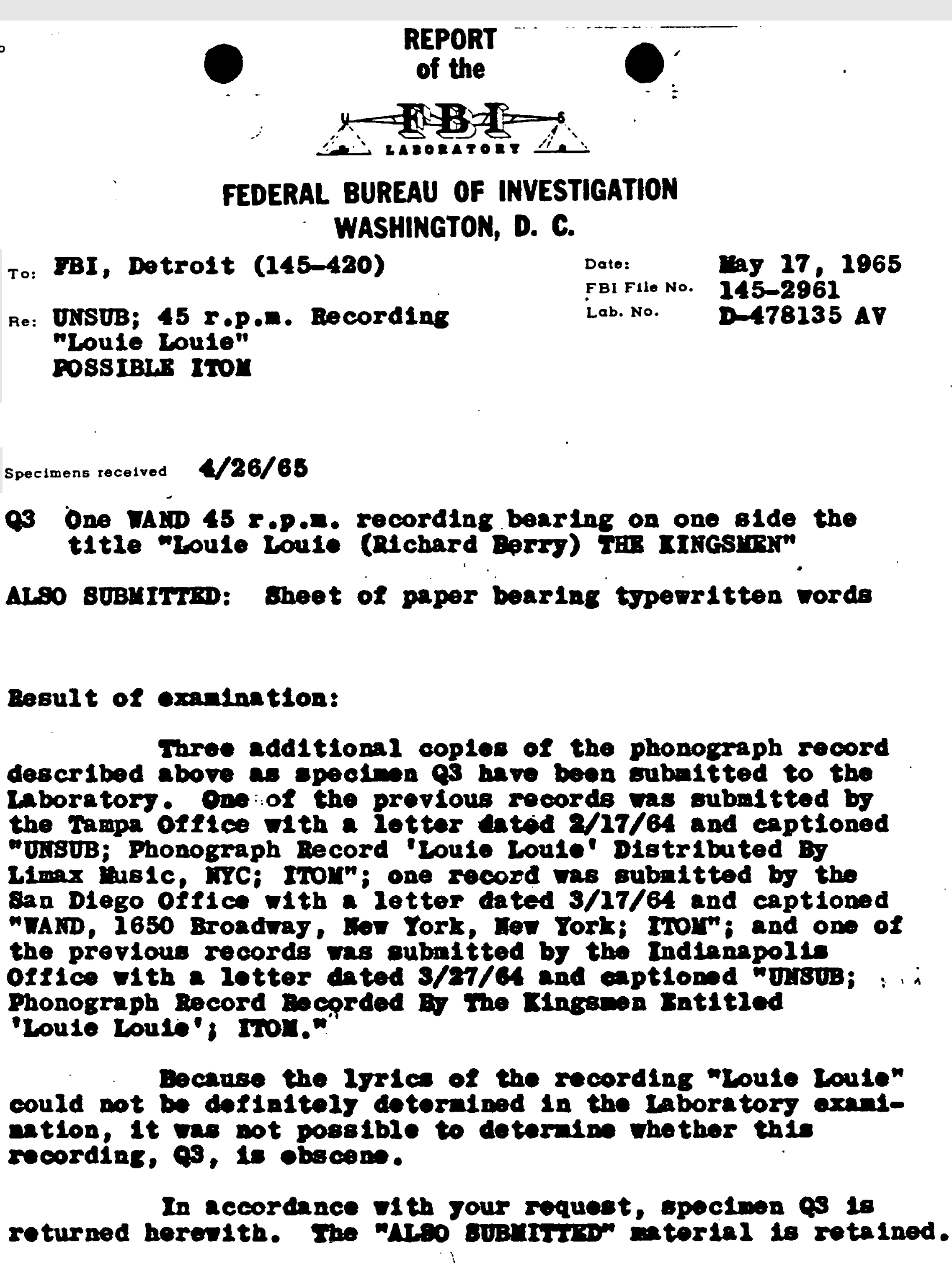
Because of its unpolished sound and edgy rhythm and blues, the song already had huge appeal, but questions surrounding the song lyrics fueled its momentum. As the controversy grew, the song was banned on many radio stations, and prohibited entirely in the state of Indiana. Of course, this meant the song was destined to take off in a big way. A concerned parent wrote to then-Attorney General Robert Kennedy, complaining the lyrics were obscene, and eventually an official inquiry by the Federal Bureau of Investigation was launched. Was “Louie Louie” really corrupting the youth of the day?

J. Edgar Hoover, head of the FBI, said about the song, “[I] strongly believe that the easy accessibility of such material cannot help but divert the minds of young people into unhealthy channels and negate the wholesome training they have already been afforded by their parents.”

Take a moment to consider what’s on the radio today!

Image

Letter from the FBI Lab, WA DC. 1965. Printed through the Freedom of Information/Privacy Act, section 202-324-5520

The guys had no inkling of how big a deal it was.  Former keyboard player Barry Curtis remembers, “All I knew was, at one point we had two singles and three LPs on the Billboard Chart at the same time, and The Kingsmen were the number one live touring band in the country.” They were on the road constantly and insulated from the outside world. In fact, it wasn’t uncommon for them to be booked once, often twice, and sometimes even three times in a day, 330 days of the year. And think of how cool it was for a bunch of teens and early 20s guys from Portland, performing with The Beach Boys, The Zombies, The Dave Clark Five, and The Rolling Stones.

They were earning $4000 a night or $6,000 on double days, so even when considering their manager’s 15 percent; 10 percent for their agents, the prestigious William Morris Agency; and hotels and expenses, they were still making more money than any of them could’ve imagined. But it wasn’t like all of the money was ending up in their pockets. The guys drew salaries and were told the rest was “being put away for their retirement.” For context, during the mid-1960s, the minimum wage was $1.25; the average family income was less than $7,000 per year; and you could fill your gas tank for $5.00. They were having the times of their lives.

Image

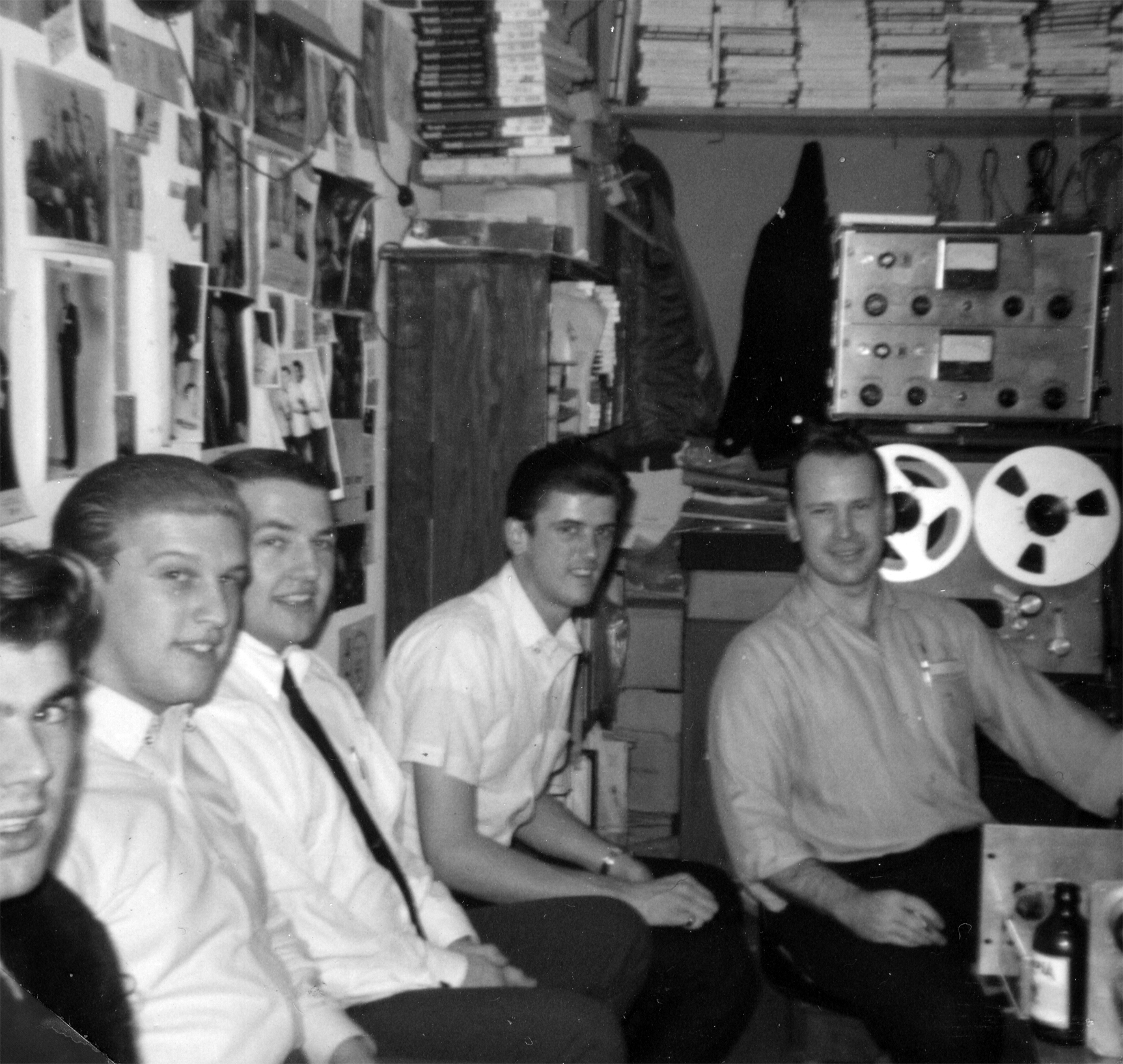
“Jolly Green Giant” recording session, Audio Recording, Seattle—1964 Left to right: Jimmy-John, Lynn, Jerry Dennon, Mike, Karney Barton (engineer) © 2006 Richard Peterson

As their fame and popularity grew, so did the FBI investigation. The Federal agents attended every concert, monitoring the band. In spite of the constant surveillance, the guys weren’t concerned until there came a knock on the door in the middle of one night, with someone saying, “This is the FBI and we are going to talk.” That was when everyone realized, for the first time—they might actually be in some trouble.

To be continued…

###

_________________________________________________________

Terri Nakamura is a professional graphic designer who loves social media, music and writing.  Follow her on Twitter: @terrinakamura; Read her blog, Confessions of a Graphic Designer: http://seattledesigner.blogspot.com/ or find her connections: http://about.me/terrinakamura

© 2010-13 Terri Nakamura

The Enduring Legacy of The Kingsmen—Part 3

“Louie Louie” — Unintelligible at “any speed”

Image

The Kingsmen lion logo © 2006 Richard Peterson

After 31 months, it ended in a Federal Communications Commission hearing. There were two possible outcomes.

The first was finding for the plaintiffs. If the song was ruled as obscene, there could be dire consequences for the band. The record would be banned and possibly The Kingsmen could be subjected to fines or worse. Finding for the plaintiffs could’ve also implicated the recording label for engaging in transporting obscene material across state lines.

Or, the judge could find for the defendants.

After listening to the song at every speed, the judge still couldn’t hear anything with certainty. Considering the lack of FBI evidence, and relying on his own ears, he ruled the song “unintelligible at any speed,” and lifted the ban.

The verdict was a triumph because “Louie Louie” began climbing the charts once again, with all rumors about the alleged raunchy lyrics intact. The guys capitalized on the situation under the guise of, “Hey, we got away with it!”

In the spring of 1964, The Kingsmen were touring with the likes of Dionne Warwick, Chad and Jeremy, Peter and Gordon, and famed DJ “Murray the K, aka ‘the Fifth Beatle’” (Murray Kaufman). They were on top of the world. And they were guests on popular shows including American Bandstand, Shindig, Hullabaloo and in the film, “How to Stuff a Wild Bikini,” starring the heartthrob of boys across the U.S., Annette Funicello.

When the British Invasion hit in 1964, its music shared the airwaves with American bands, and instead of being seen as competition, their music was appreciated by everyone, including The Kingsmen, who by then were like ambassadors of American rock. But when the ”psychedelic era” hit mid-decade, the new musical expression reflected a seismic shift in society and culture.

Image

Actual schedule hand-written by Murray Kaufman, posted backstage for Easter Extravaganza, March 1964 © 2006 Richard Peterson

The decade ended with Woodstock. By that time the guys recognized they weren’t “what’s happening,” and though their popularity waned, their music continued to influence other bands of the day, even laying the groundwork for the “garage band sound.”

Curtis muses, “It all starts somewhere. We were all influenced by other people. It wasn’t so much that we influenced established bands, but we influenced a lot of local bands. Young bands today—they just keep that whole thing going.”

To be continued…

###

_________________________________________________________

Terri Nakamura is a professional graphic designer who loves social media, music and writing.  Follow her on Twitter: @terrinakamura; Read her blog, Confessions of a Graphic Designer: http://seattledesigner.blogspot.com/ or find her connections: http://about.me/terrinakamura

© 2010-13 Terri Nakamura


The Enduring Legacy of The Kingsmen—Part 4

The Lawsuit That Forever Changed the Music Industry

Malcolm Gladwell talks about the “10,000-hour rule,” in his book, Outliers. It describes the volume of experience people accrue to reach a perfected level of expertise. When asked how much time the band spent honing its craft, Peterson thought back. “It wasn’t unusual to play 11 hours a day including performing, practicing and playing around while traveling from gig to gig.” This would mean nearly 20,000 hours over the course of five hard years on the road!

As years passed, band members began to wonder where the money that had been “put away” had gone, and why they weren’t receiving royalties for their songs that were being used and sold. So Peterson filed a lawsuit against the owners of the master recordings to regain ownership of their music. When he filed the suit, it was similar to when they recorded the demo of “Louie Louie”—it was much more important than anyone could have anticipated.

In April of 1998 the judgment in Peterson’s favor was granted. It was groundbreaking. And in November of 1998, the Supreme Court declined an appeal filed by the record companies.  At last, many acts were able to regain ownership of their own master recordings, and it forever changed the way record companies must treat talent.

The lawsuit was huge for the entire music industry. In 2002, also recognizing their mark on rock and roll, The Kingsmen received Lifetime Achievement Awards from The Grammys. Added to their three gold records and countless accolades, it was a great validation. When asked how he felt about Rolling Stone Magazine calling “Louie Louie” the fourth most influential recording of all time, Dick Peterson can’t help but agree, “It is incredibly great.”

Image

Photo: Current drummer Steve Peterson with Grammy award in his Seattle recording studio © 2010 Steve Peterson

The Kingsmen have been a working band for 52 years, and the guys still rock out every chance they get. Current drummer Steve Peterson (no relation to Dick) says as long as the members continue to breathe, their plan is to keep playing, because they believe there is room for what they do. They won’t attempt to change up their act with the music that’s currently popular, but they’ll continue playing their music, and new music with a ’60s flavor to it.

As for new Kingsmen music, Steve Peterson offers this recap: “There’s nothing in the works, but we’re all writing and producing music for other projects. Dick is working on a soundtrack for a movie; Dennis Mitchell  (younger brother of original and current band member, Mike Mitchell) is writing for The Dennis Mitchell Band; and Barry and I are writing songs for another Seattle band, The Daily Flash. “

And the future of The Kingsmen? “Many of the places we used to play are now using bands from the ’80s instead of the ’60s, so we’re playing less frequently,” says Steve Peterson. “I just hope we can keep playing as long as we can.”

Of those days, Brien Beirne sums it up nicely: “Rock and roll was young, and you should have been there.”

It’s unknown how many versions of “Louie Louie” have been recorded, but according to LouieLouie.net, it’s believed to be more than 1,500.

###

_________________________________________________________

Terri Nakamura is a professional graphic designer who loves social media, music and writing.  Follow her on Twitter: @terrinakamura; Read her blog, Confessions of a Graphic Designer: http://seattledesigner.blogspot.com/ or find her connections on xeeme:

© 2010-13 Terri Nakamura

_________________________________________________________

Memories of a DJ

ImageThird of an eight-part featuring the legendary rock group, The Kingsmen

Brian Beirne, “Mr. Rock ‘N Roll,” Reminisces

My dad took me to a radio station when I was 10, and I watched a guy spin the records, cue them up and talk about them. Elvis had just hit and was the rage of the day, and of course all of us kids wanted to pick up a guitar and be the next Elvis Presley. I played piano and guitar, but once I watched the guy in the studio, that was it.

I was a record collector from the time I was four. The magic words for me were, “Hey kid, see the records underneath the console? When we get done with them on the playlist, we get to take them home. And I thought “Wow, this is great. I’d get to play the records on the radio, talk about the artist, physically handle the records, and then I’d get FREE records!”

What’s interesting is, when my dad passed away several years ago, I opened the family trunk and saw my birth announcement. It was a baby holding a microphone. It was prophetic. Blew me away. I guess that was my calling. And I enjoyed every day I was on the radio in my 40+ years, and of course I got to meet great people along the way—got to have them on my radio shows wherever I was in the country—got to work with them, book them on shows, hang out with them and have fun. It was a fabulous career.

It was the “Golden Age of Rock,” and to a great degree, the second golden age of radio. We had freedom as disc jockeys. Today it is extremely controlled. You’re given a playlist. You’re told don’t talk over so many seconds, don’t do this, don’t do that. Back then, the personality of the DJ was really important. Now people seem very interchangeable. It was an exciting time to be on the radio. It really was.

When I got into radio, stations were owned by “moms and pops.” There were only a few major companies that owned radio stations, and there were restrictions—you could only own so many AM and FM stations, and so many television stations. I think there was a lot of freedom in the industry. Disc jockeys were stars. We were talent. We had a following like celebrities. It was exciting, too, because somebody would walk in the door that afternoon and say, “Hey, we’re The Kingsmen, and we have a brand-new record out, and do you want to give it a spin?”

I started in radio by accident when I was 13. I hung around the radio station from the time I was 10. Three days a week I’d take the bus there after school. I’d hang around and watch the guys, get them coffee, pull their records, and they would teach me the ropes.

One evening there was a live broadcast from the YWCA. Though I was shy, I’d go and hang around with the DJs. About a half hour into the broadcast, the jock said, “I’m sick. I’m going home. You take it.” And I said, “What do you mean, ‘me take it? I’m a 13-year-old kid!’” And he said, “You know how to run this!” So, the next thing I knew, I was on the radio. That lasted until my mother thought I actually was going to find girls down there at the radio station and put the kibosh on it. I went back into radio full time when I was about 17 and moved around the country to various cities. I was working in a major market by the time I was 21 and eventually settled in Los Angeles for 29 years at The Earth 101.

When The Kingsmen started to hit big I was 17. I remember when they recorded the live album at The Chase. I was on the air and the guys came by with a new record—they were always trying to crack me up, and I remember all of them, probably led by Mike Mitchell, when I opened the mike, they were in the production room across from me, all mooning me at the same time. In those days we had to read a five-minute newscast at the top of the hour, even Top-40 stations. I’d find myself reading the newscast and these guys are mooning me across the way to see if they could break me up. We had a lot of good times and I think that whole sound they produced at that time with “Money,” “Little Latin Lupe Lu,” “Jolly Green Giant,” were all really, as I said, not a polished sound, but it was exciting. It was new.

So many great memories and it all happened so fast, because right after that I started to do a lot of package shows that had five to 10 acts together. One day The Dave Clark Five are on your radio show, the next day it’s The Mamas and The Papas, then The Kingsmen drop by with a new record—it was kind of a whirlwind—the experiences and people I met during that period of time.

In terms of most amazing moment, there wasn’t a particular event, but more like the cumulative experience of being in that business at that point in time. Lots of exciting things happened. The Kingsmen were swell people and it was wonderful to be a part of their career at that time.

_________________________

Terri Nakamura is a professional graphic designer who loves social media, music and writing. Follow her on Twitter: @terrinakamura; Read her blog, Confessions of a Graphic Designer: http://seattledesigner.blogspot.com/ or find her connections on xeeme: http://xeeme.com/terrinakamura
© 2010-12 Terri Nakamura

The Beat Goes On

First of an eight-part series featuring legendary rock band, The Kingsmen

Photo by Raphael during our stay in L.A. shooting ‘How to Stuff a Wild Bikini.’ Pictured L – R: Mike Mitchell, Barry Curtis, Dick Peterson, Lynn Easton, Norm Sundholm

As told by Dick Peterson, The Kingsmen drummer, 1963-present

When I was young, I found everything on the radio influences you.

The Kingsmen started as kind of a “hootenanny” group, with acoustic guitars and a stand-up base. And as that music changed — when the electronic stuff came in; The Ventures and surf music started to take off — then the band got electrified and did that for a while.

When the Wailers became popular in the Northwest and put out an album called “The Fabulous Wailers at the Castle,it became an album that all bands from the day learned. Our band was sort of a butterfly that was being molded by all the influence around it. And then it gained its own recognition — and its own sound.

We recorded the quintessential version of “Louie Louie.” Because of our naiveté with regards to why kids were coming to see us (the lyrics of “Louie Louie” were allegedly obscene), we thought it was comical when the F.B.I. started to investigate us. I was 17 at the time.

I cannot believe we hit the road and had absolutely no clue what we were doing, especially regarding the business. We just had no clue. And the impact that “Louie Louie” was having nationally — we just didn’t even see it. We were playing a different show in a different town night every single night and we were really out of touch except for what people kept saying, you know — “What about the FBI? What about this word? What about that word? What about these lyrics?” We kept denying it. We thought it was funny. It was like, “You think it says WHAT? Are you kidding?” We were the bad boys of rock and roll, but we were naive and innocent.

We were on the road all the time and had to find ways to amuse ourselves. We destroyed a hotel room once, out of fun. It wasn’t because we were drunk or drugged out. No one’s been into that stuff. Our worst moment was, we shot up a hotel room. We had been on the road playing double days for six months—a morning concert in one city and an evening concert in another. It would often be a high school assembly in the afternoon, then a dance in the evening a hundred miles away. We were going crazy and wanted some time off.

We finally got a day off and were in a hotel — a Holiday Inn, actually. It was right across the street from a gun shop. So, someone, I think Jimmy (our road man) bought a dart set. Then it escalated and someone bought a pellet gun. Then it was like, “Let’s open the door and see how far away we can get from that target and still hit it. You couldn’t get very far, but hey! A 22-calibre rifle could shoot from further away! With the doors open and across the parking lot, we wanted to see if we could hit something. We didn’t know it destroyed anything until we went to check it out.

You know those cinder block walls? Yeah, oh boy. When we checked it out and Jimmy removed the target, the only place that was not hit was where the target was. We checked out and left. Our managers called and were angry with us. It cost us a little bit of money to repair things. There was not a sign on the highway that we didn’t hit with a pellet gun, bottles or bottle caps.

When you think of what we were making and how hard we were working, it came to almost $2 million per year. When we decided we weren’t going to play psychedelic music and it was time to leave the road, there was nothing left. Our handlers had taken everything. We had worked really hard for five years and had nothing.

We initiated a lawsuit when we suspected the record company might have victimized us. We knew our recordings were released on other labels and felt we should be receiving royalties, but without management or legal representation, we had no idea how to collect them. We went into the lawsuit not only for the royalties, but with the claim to all rights associated with the master recordings. Winning that case was earth shaking. All sorts of acts have filed and now own their own material. They’re making a fortune. We’re making a lot of money, but the problem is, it’s all going to the attorneys, still. We’re close, though.

It makes me feel great to have Rolling Stone magazine called “Louie Louie” the fourth most influential recording of all time, and I completely agree with them. Beside the cultural significance, I think for anyone who wants to play an instrument, you play “Louie Louie” and you would be encouraged. Here something that’s sold who knows how many millions copies, and it has three chords. Anyone in the world can play it.

We’re one of the few acts of that era that are still performing nationally. The Kingsmen have always just played, not arranged and practiced stuff. You could play the same song 10 times and it would be different each time. We don’t rehearse. We talk about rehearsing. It’s like, someone will say, “Do you know this song? Do you know what key it’s in?” I’ve heard it before and we talk about it and it’s fine. Our attitude is — have fun. •

Above photo © 2006 Richard Peterson

____________________________________________________

Dick Peterson joined The Kingsmen in 1963 and has written a book,
“Louie Louie Me Gotta Go Now”

____________________________________________________

Terri Nakamura is a professional graphic designer who loves social media, music and writing. Follow her on Twitter: @terrinakamura; Read her blog, Confessions of a Graphic Designer: http://seattledesigner.blogspot.com/ or find her connections on xeeme: http://xeeme.com/terrinakamura

© 2010-12 Terri Nakamura