Keeping kids safe on social media. Photo: Unsplash with Andrej Lišakov
Social Media’s Impact on Kids – What’s Next for Tech?
During my four days at the Consumer Electronics Show (CES), I had the opportunity to attend only one panel discussion. I’m grateful that I chose to listen and see this particular one in person.
A lengthy queue of eager attendees had formed, all looking forward to hearing insights from the three distinguished speakers, including Mitch Prinstein from the American Psychological Association (APA), Megan Jones Bell from Google, and Ravi Iyer from the USC Marshall School’s Neely Center. The panel was expertly hosted by Corbin Evans, Senior Director at APA.
While my own children are now adults, I find myself thinking about the impact of electronic devices and the potential repercussions of allowing young children access to social media platforms. This concern has taken on a greater significance since I’ve become a grandparent.
The dynamics of social media engagement are vastly different for adults compared to the experiences of children and teenagers. Most adults, myself included, can navigate platforms like Instagram without getting caught up in the potential negative experiences. My personal journey with social media journey dates back to the early 2000s and I’ve been fortunate to encounter very few negative incidents. This contrast underscores the importance of distinguishing between adult, adolescent and pre-teen use.
In sharing this summary, my hope is that it sparks interest among parents, educators, and all who share concerns regarding the profound influence of social media on our kids. It’s a topic that deserves our collective attention as we seek to safeguard the well-being and development of younger generations.

L-R: Corbin Evans and Mitch Prinstein, APA; Megan Jones Bell, Google; Ravi Iyer, USC Marshall School’s Neely Center. Photo © Terri Nakamura
Mitch Prinstein, Ph.D., Chief Science Officer, APA
Mitch Prinstein asked the question, did problems get worse when social media began? He talked about the lack of specific data that correlated between social media and negative effects on mental health including suicide, weight gain or substance abuse. They’re unable to say the current youth mental health crisis has been caused by social media.
When kids are asked, they report a wide array of reasons that affect their mental well-being, such as school shootings, exposure to violence and sexual assault, unrealistic academic pressures, increased polarization, climate change and leadership critique of underrepresented identities. These things exacerbate the current situation, but none are the singular cause of the current mental health crisis.

Image: Mitch Prinstein, APA
It’s important to consider that the adolescent brain isn’t fully cooked, and that teenagers and their developing brains are affected by social media. Even though these platforms were made for adults, kids use them instead, and especially when their brains are changing the most.
During this time when the adolescent brain is changing, the rapidity of change is second only to the changes during the first year of life. The first area of the brain that changes is the part that makes kids roll their eyes, especially at their parents. Prinstein says it’s because of the proliferation of dopamine and oxytocin receptors in an area called the anterior cingulate cortex.

Graphic: Mitch Prinstein, APA
They suddenly become very sensitive to what their peers think, and very interested in avoiding anything that could cause them harm or a social consequence. This is happening around the age of 10, 11, 12 when there is a hyper-charged desire to connect with peers.
Not many years later, we see the full capacity of the pre-frontal cortex, the last area of the brain to develop, which is like the “brain’s breaks,” or the inhibition center that stops people from pursuing every impulse they have.
Between the ages of 10 and 25 is when we see the most social media use. A lot of kids are getting their phones at the time when they’re desiring so much interaction with peers. And they’re unable to stop themselves from the hyper engagement with social media platforms for many years to come.
What Scientists are Asking
Scientists don’t usually ask if social media is all good or all bad. The scientific community is asking a variety of other questions to try to understand the effects of digital media on adolescent development. In what ways is social media benefitting or fostering the development of important competencies or relationships?
What are the ways kids are showing problematic effects of social media use, like addiction? What are the opportunities that kids miss each minute they’re on social media, like sleep and exercise? What ways are kids more susceptible to misinformation?
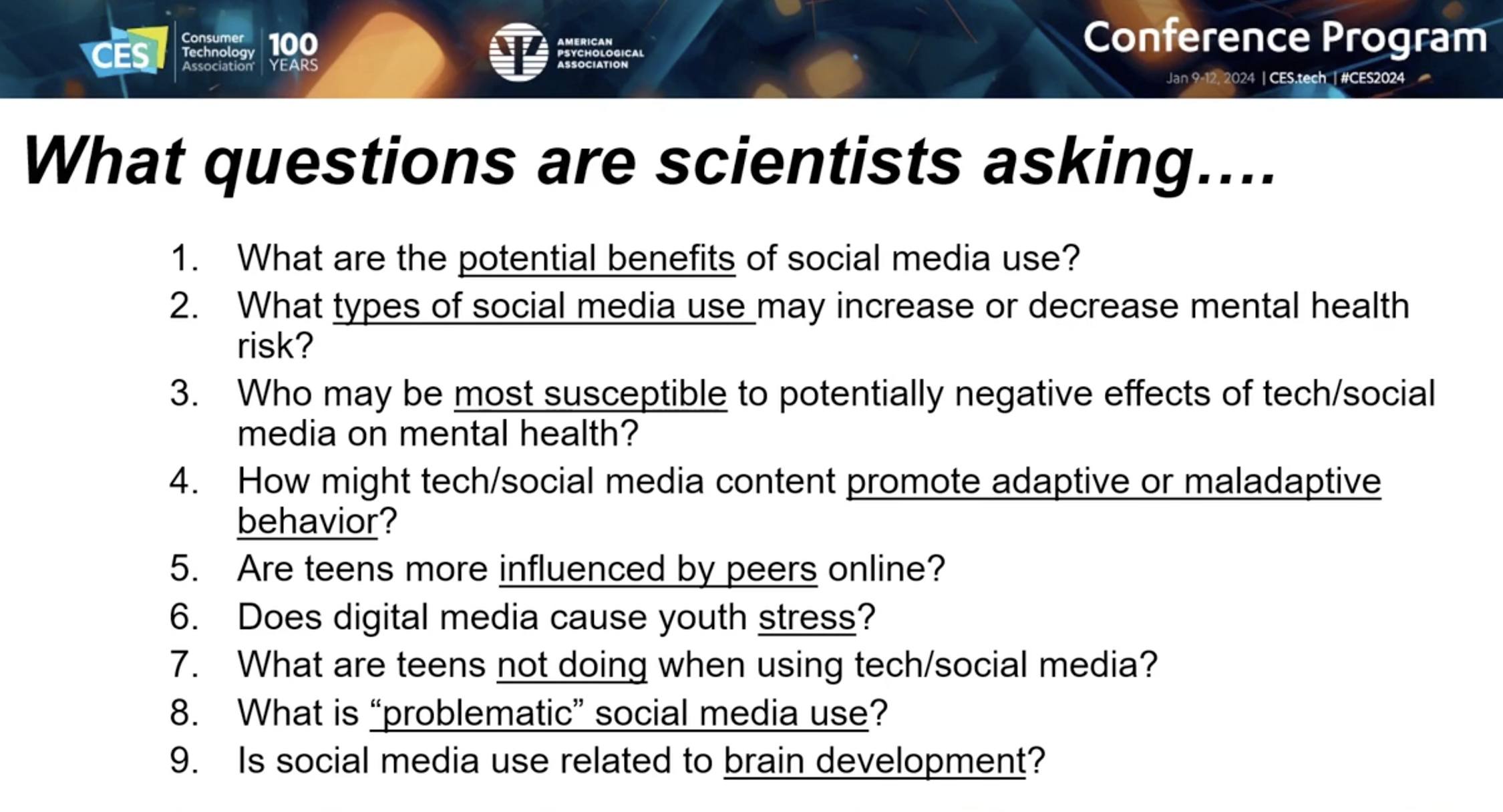
Graphic: Mitch Prinstein, APA
The APA created a summary of this information in the APA Health Advisory on Social Media and Use in Adolescence: https://www.apa.org/topics/social-media-internet/health-advisory-adolescent-social-media-use

Graphic: Mitch Prinstein, APA
Overall, when we talk about social media, there are 3 separate aspects.
- Content on SM that kids generate, seek out, or things that are presented to them
- Specific features of SM, the “like button, the endless scroll, the follower counts — these are things that are new and different and change our social relationships.
- The AI piece, which is new and evolving, and we know less about.
Parents wonder how much time their kids should spend on social media. If they’re reading the New York Times and talking with their friends about political issues, maybe 20 hours a day? joked Prinstein.
But if they’re on SM and being directed to content on how to cut themselves and how to keep it from their parents, less than a minute would be too much.
We have to think about ways of building competencies that could help their development.
You can google APA Health Advisory on Social Media and get our entire document so parents, teachers and other can see what science is saying. (again: https://www.apa.org/topics/social-media-internet/health-advisory-adolescent-social-media-use)
10 Recommendations for Parents, Platforms and Policymakers
- Build and encourage use of functions that promote socialization
- Tailor platform design, functionality, and permissions to developmental capabilities
- Monitor use for early adolescents
- Remove content and mininimize exposure to content that promotes illegal or psychologicall maladaptive behavior
- Remove content and minimize exposure to content that promotes prejudice, hate or cyberbullying
- Routinely screen for signs of problematic use
- Limit use that interferes with sleep and physical activity
- Limit use that encourages social comparison
- Precede use with training teens in social media literacy
- Provide resources for continued research on the positive and negative effects of social media on development.
(Excerpted from the graphic below.)

Graphic: Mitch Prinstein, APA
Our recommendations are reflective of a scientific perspective, on how social media can be used to foster healthy and adaptive social milestones, but we need parents to be monitoring social media use. Not looking over their shoulders, but to talk with their kids about what they’re experiencing on social media.
We’re asking tech companies to really think about the adolescent brain and its unique vulnerabilities and capabilities, and to think about making the experiences of an 8 year old on social media different from the experience of an 80 year old on social media. We’re looking at different ways to screen for problematic use, we’re calling for a take down discriminatory and harmful content — content that encourages maladaptive or psychiatrically disordered behavior.
In particular we’re interested in fostering a conversation around social media literacy. We don’t just give kids the keys to a car and wish them luck as they head down the driveway. We make sure they know how to operate a car in a way that would be safe for themselves and others. With social media, there are no tests to demonstrate that they have the competency to understand fake profiles, mis- and disinformation, how to combat cyber-hate and how to engage in adaptive ways of solving interpersonal conflict. This is based on psychological science. Psychologists have developed interventions to teach kids these skills effectively, so we have those tools. It’s time to bring them to scale.
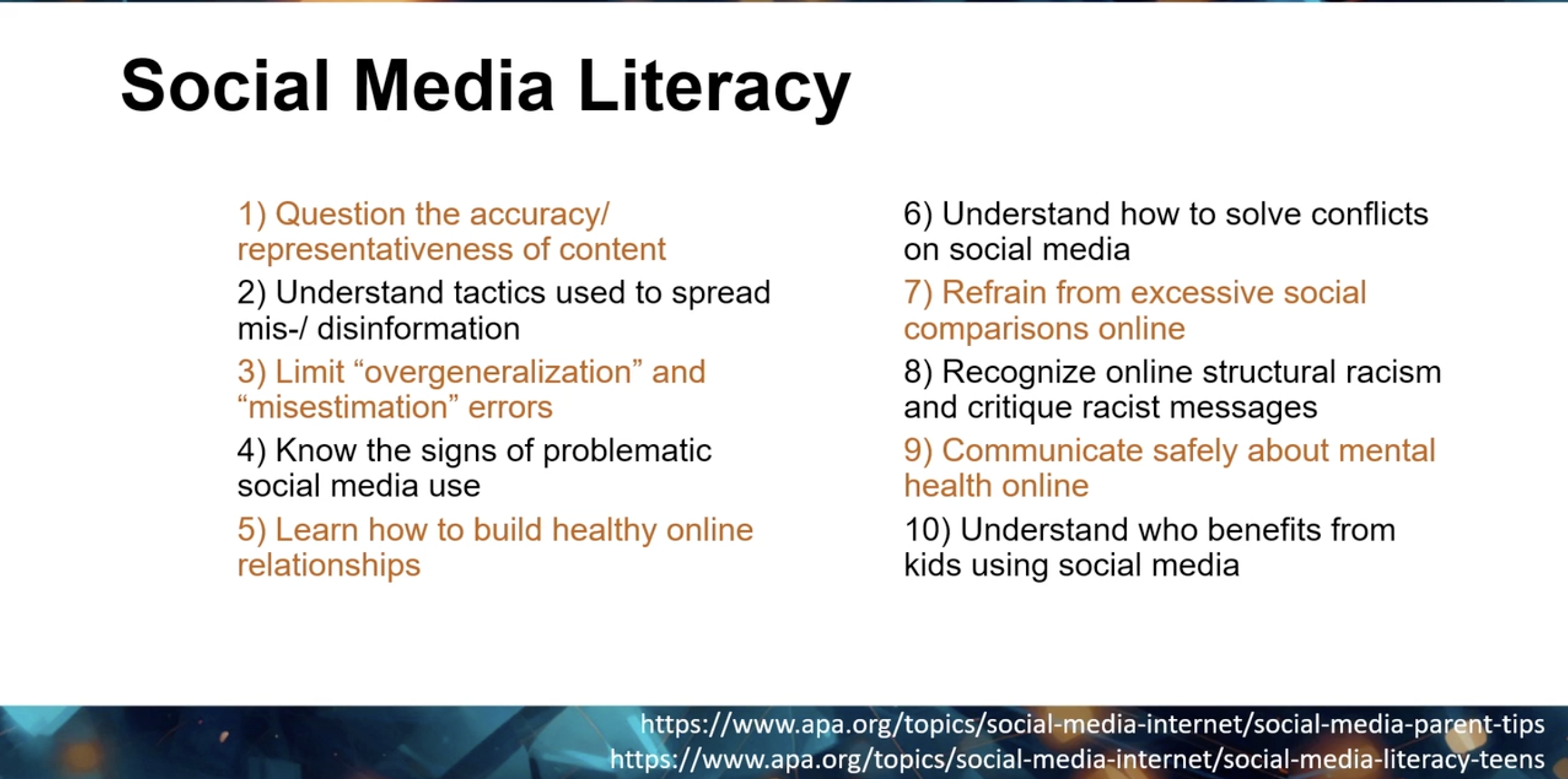
https://www.apa.org/topics/social-media-internet/social-media-parent-tips
https://www.apa.org/topics/social-media-internet/social-media-literacy-teens
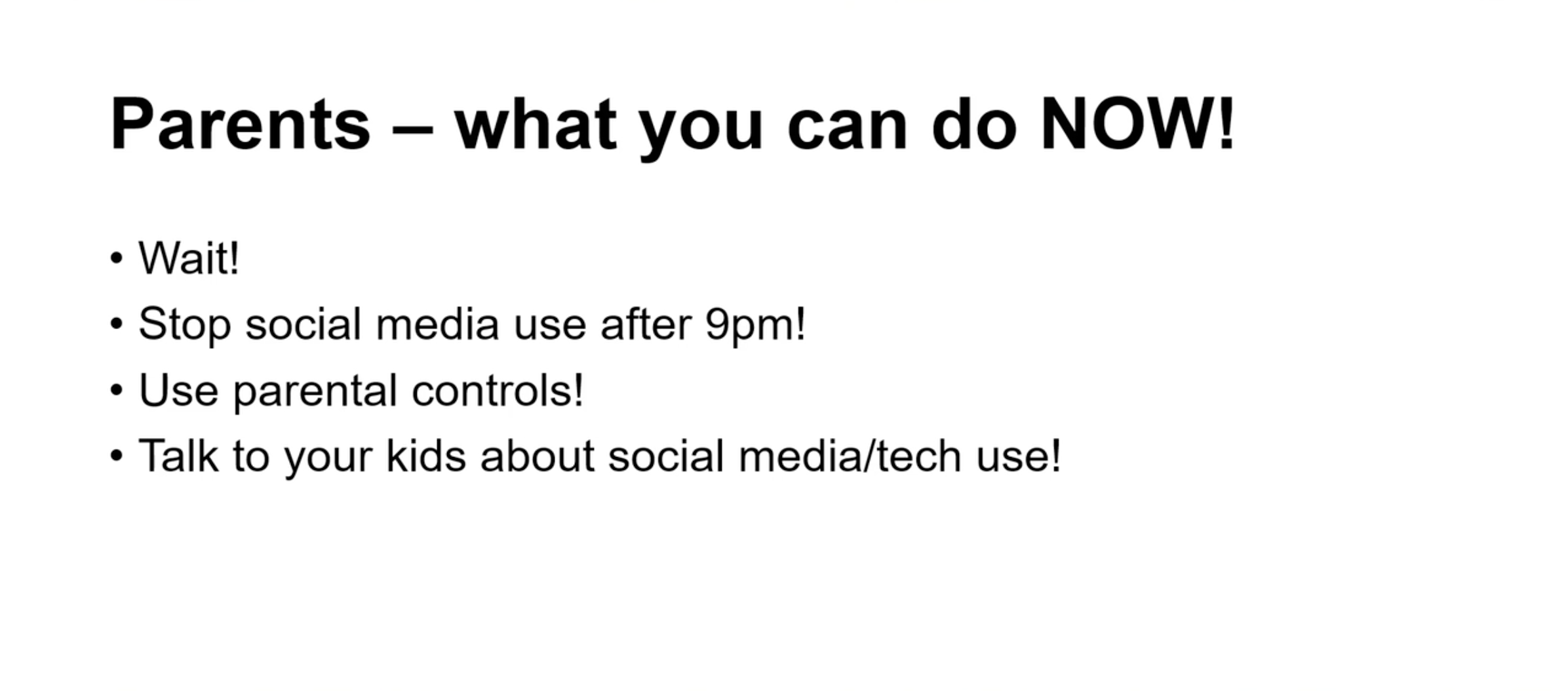
Parents can do so much in this space. There is no psychological science that shows kids are harmed by NOT being on social media. We can stop social media use after 9 PM, use parental controls, and build social media competency.
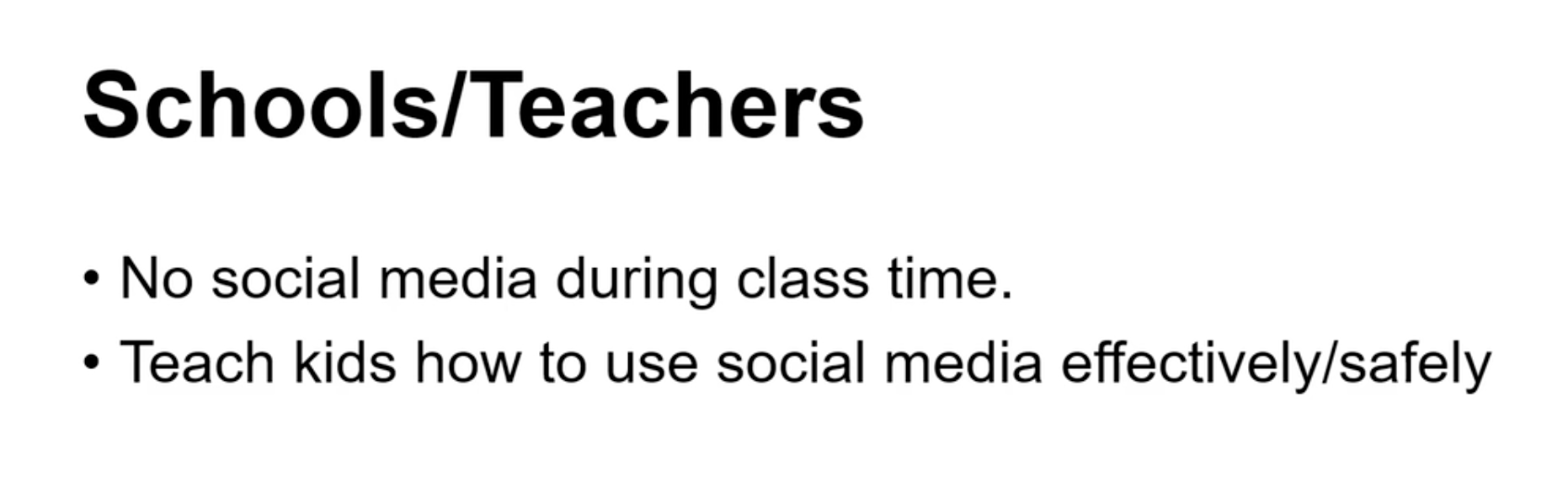
Prinstein suggested that social media should not be allowed during class time, and that schools/teachers should be teaching kids how to use social media safely, and that educators should be teaching kids about the online world. (My note: I’m not an educator, but I have an issue with integrating social media into schools. I see teachers as being burdened with integrating societal changes, which has had a significant impact on their work, and I doubt that educators have the capacity to handle “one more thing.”)
We need to get lawmakers to make sure that kids and their data are protected and we’re not sacrificing their development to help others make a profit.

And we need the tech industry to think of ways that they can put child safety over the model of increased and constant engagement. There are ways this can be accomplished, and that’s what we hope for.

Megan Jones Bell, PsyD, Clinical Director, Consumer and Mental Health, Google
Megan Jones Bell leads consumer and mental health across Google. She shared an overview of how Google approaches the objective of keeping kids and their mental health in the spotlight, highlighting their work on YouTube.
Google is all about creating online experiences that empower kids. Its goal is to provide enriching, safe, and age-appropriate online spaces that respect children’s unique needs while giving families control over technology. Jones Bell said Google builds these experiences with safety in mind from the start, and she shared some recent work done on YouTube, although the efforts extend across Google products.
Jones Bell focused on recent work they’ve done on YouTube. Kids’ mental health, which requires special protection online. They’ve developed 5 Youth Principles that form the core of the work that Google does to create a safer and more enriching environment.
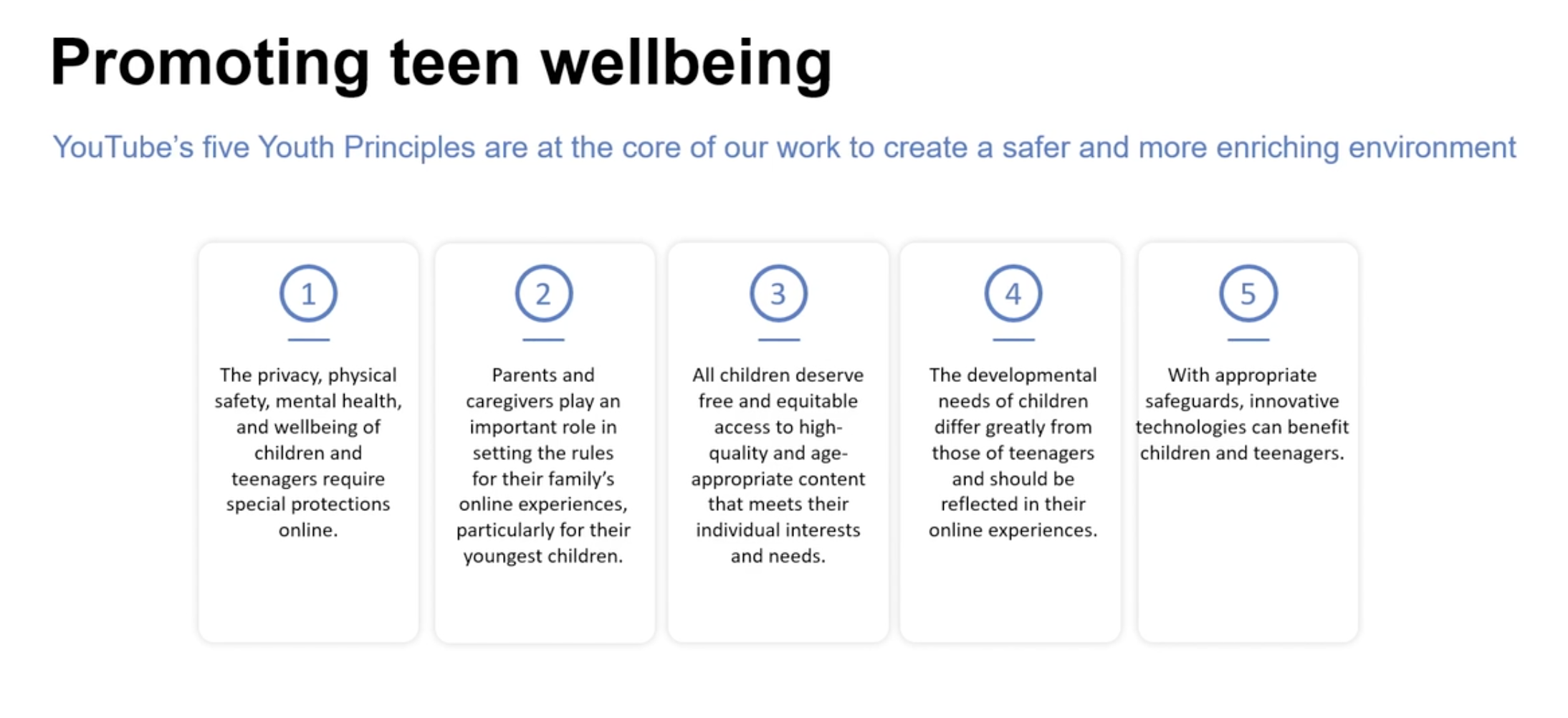
Image: Megan Jones Bell, Google. (Excerpt from graphic, below)
- Kids’ mental health requires special protection online
- Parents and caregivers should have a say in how technology is used within their families.
- Every child deserves access to high-quality, age-appropriate content that suits their interests and needs.
- Developmental needs of children differ from teenagers’, so tech should reflect that.
- With the proper safeguards, kids can benefit from and use innovative technologies.
Google has already introduced features like “take a break” and bedtime reminders in many Google products, but they’re enhancing them to be more effective by creating moments for pause and reflection.

Image: Megan Jones Bell, Google
One thing they’re about to roll out is an all-screen takeover (third panel). These will be more disruptive and create more moment to pause which we know is more likely to get someone to disengage.
They’re also changing the way they recommend content by focusing on limiting repeated suggestions of videos that might promote unhealthy social comparisons or social aggression among young viewers. They’ve been eliminated from the “watch next” algorithm on YouTube.
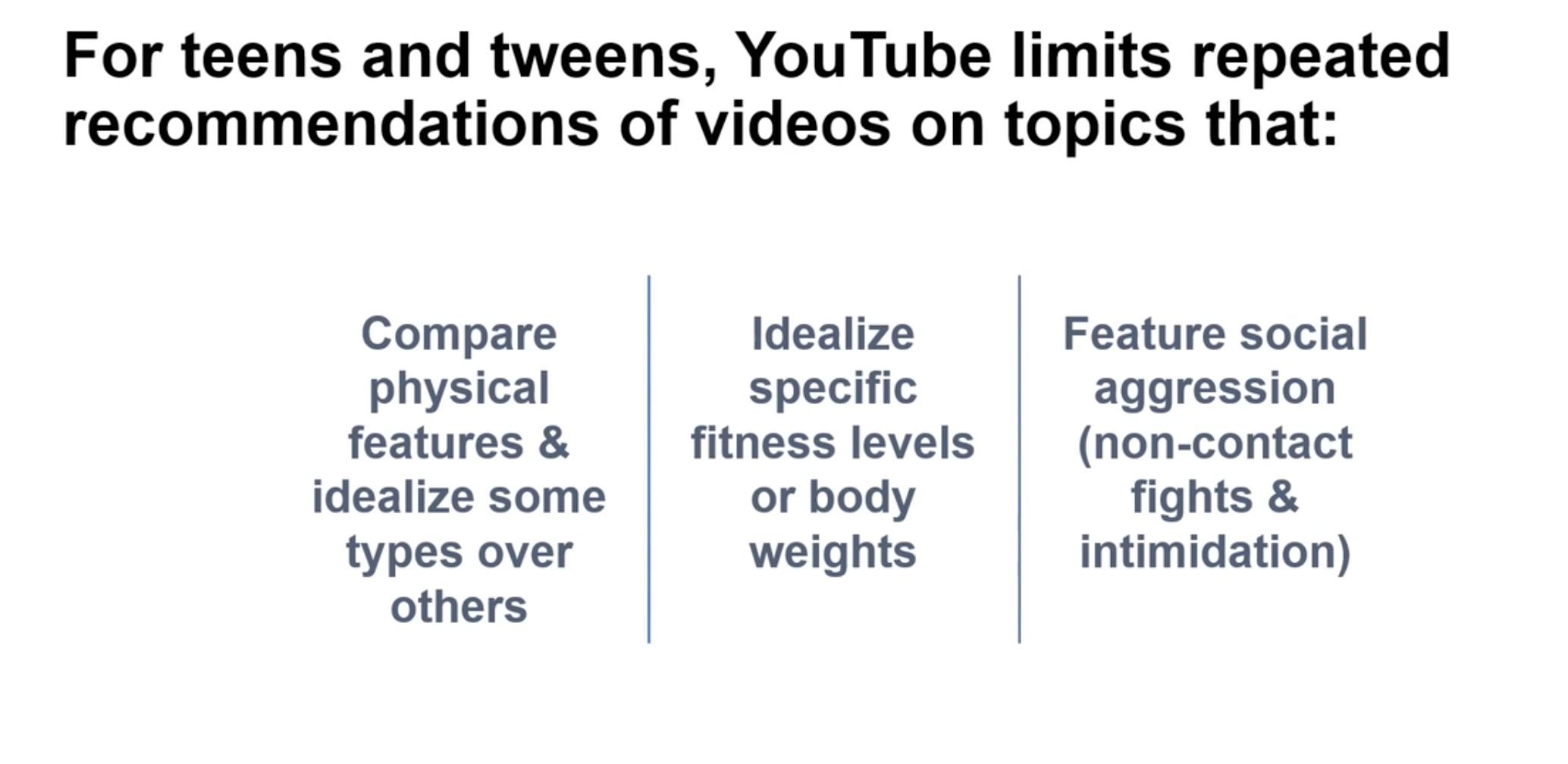
Image: Megan Jones Bell, Google
Google wants to ensure that the content they suggest is safe and positive. To support users during difficult moments, they’ve updated their crisis resource panel to encourage safer searches and offer crisis resources more prominently. (It was a small blue bar in its earlier iteration, but the new “pause” page on the right, is a full-screen takeover.) This way, people are more likely to find help when needed.
We know from our research that slowing people down in moments of crisis will lead to disengage from problematic search.

Image: Megan Jones Bell, Google
In terms of promoting high-quality health information, they’re working to elevate high-quality mental health content for young teens by collaborating with experts at the National Academy of Medicine and organizations like the World Health Organization. They’ve also partnered with Common Sense Networks to provide training and resources for creators, helping them make responsible and helpful content and promote digital well-being. These are just some steps they’re taking to create a safer and more enriching online environment for kids and teens.

Image: Megan Jones Bell, Google
Ravi Iyer, Managing Director of the USC Marshall School’s Neely Center
Ravi Iyer was present to discuss how we can design social media to have a positive impact on mental health. While social media isn’t solely responsible for mental health issues, there are ways to make it better for those who are affected negatively. Here are two key takeaways:

Platform Accountability: We should hold social media platforms accountable for their design choices, not just the content they host. Creating spaces that discourage harmful activities and incentivize positive ones is essential.
User Experience Surveys: We can use surveys to gauge user experiences and validate whether platforms improve their design. By listening to users’ concerns and feedback, we can ensure that the changes implemented align with their needs.

During his time at Facebook, he realized that existing policies didn’t cover some harmful behaviors, such as fear speech and subtle misinformation. They focused on design changes to address this, like removing engagement incentives that encouraged negative interactions. They also introduced rate and functionality limits to prevent a small group of users from dominating discussions.
These ideas have been compiled into a design code for social media. It acts similarly to building codes. While preventing every bad thing from happening online is impossible, we can hold platforms responsible if their design choices promote harmful behavior. By doing so, we aim to empower users to engage with content that aligns with their aspirations rather than just what grabs their attention.


Says, Iyer, “We’ve started measuring user experiences by asking people about positive and negative encounters on social media platforms. This helps us understand which platforms are improving and where improvements are needed. For instance, LinkedIn stands out for having fewer negative experiences and fostering a more positive environment.”
In the world of AI, we’re also keeping an eye on user experiences to catch potential harms early as AI adoption grows.
In summary, we can create a healthier online environment by holding platforms accountable for their design choices and continually measuring user experiences to ensure progress.
Postscript
CES, one of the largest global tech events in the world, offers thousands of compelling reasons to be make the pilgrimage.
Among the foremost is the chance to be present for groundbreaking product launches. It’s a place where B2B deals and investments are made. It’s a chance to witness the debut of inventions and feel the sensation of the future unfolding before your eyes. You can not only observe but actively interact with innovations. The experience far exceeds articles on the Internet, or mere observation.
We have access to the stories and inspirations behind new technology that exemplify how visionary founders and engineers were driven to bring their dreams to fruition. We can hear from the inventors first-hand and feel the passion fueling their journeys.
In addition to introducing new technology and innovations, CES is a knowledge hub where industry luminaries deliver breaking news at press conferences, and lead thought-provoking panel discussions. These sessions provide an invaluable opportunity to glean insights into the ever-changing landscape of our world. The perspectives are the most up-to-date and feature the best practices across various sectors.
The “Social Media’s Impact on Kids” session featured a stellar panel of speakers. They offered rare glimpses into the behind-the-scenes initiatives driving research and policy, bringing changes to the forefront. It was a journey into understanding the relationship between education, research, and technology, showing how these forces combine to safeguard our children and families.
I did my best to accurately represent the concepts shared by the panel. Any omissions while conveying their thoughts, were unintentional.
In closing, thank you for your interest in this post. CES is the convergence of innovation, knowledge, and potential in technology. It’s a realm where the future is not a distant idea but a tangible reality waiting for us to explore. It was my privilege to take part.
Additional Information:
There are countless resources to support consumers who seek information on social media and its effect on children and adolescents. Here are a a few links to articles related to this post.
Social Media Literacy:
https://www.apa.org/topics/social-media-internet/social-media-parent-tips
https://www.apa.org/topics/social-media-internet/social-media-literacy-teens
Global principles for identifying credible sources of health information on social media:
https://www.who.int/teams/digital-health-and-innovation/digital-channels/global-principles-for-identifying-credible-sources-of-health-information-on-social-media
Health advisory on social media use in adolescence
https://www.apa.org/topics/social-media-internet/health-advisory-adolescent-social-media-use
Neely Center Design Code for Social Media
Leveraging Google’s Technology to Improve Mental Health
https://researchblog.duke.edu/category/responsible-conduct/
Common Sense – Prepare Your Students for Success in a Connected World
https://www.commonsense.org/education
More about Terri
Her book: Blogging on Instagram
Her store on Alki Beach: Alki Surf Shop
Her business: Terri Nakamura Design+Social
Terri Nakamura on Twitter
Alki Surf Shop on Twitter
The Horsfall House on AirBNB
Terri Nakamura on Linktree











 Close friends and colleagues know I’m a fan of Bloomberg Business Week. It’s the only publication I receive as a physical magazine. After dropping a signed first edition of Zadie Smith’s “White Teeth” in the bathtub, I vowed to never read anything more than a magazine while soaking.

 n
n


 Stories, Social Media & Tech